

A solid technical specification template is supposed to be the blueprint your engineering team needs. It's the critical translation layer between an ambitious business goal and the concrete plan to build it. But let's be honest, most of them are bureaucratic chores that end up gathering dust in a forgotten Confluence page.
The Blank Page Before The Code Storm
We've all been there. A brilliant idea, a fired up team, and a vague one liner in a project ticket.
What usually follows is a chaotic storm of Slack messages, conflicting assumptions, and endless meetings trying to pin down details after the work has already started. It's a perfect recipe for confusion and wasted effort.
I still have nightmares about one feature that spiraled into a multi sprint disaster. It began with a simple request, but without a shared technical spec, every engineer built their part based on their own interpretation. The integration phase was a complete train wreck. We spent more time fixing misaligned components than we did building the actual feature. I think I aged a year in that one week.
That painful experience taught me a vital lesson: a proper technical spec isn't bureaucratic overhead. It's a communication tool that saves time, cuts down on risk, and gets everyone pulling in the same direction.
Why a Tech Spec Is Your Best Defense Against Chaos
Think of a well crafted tech spec as your project's architectural blueprint. It stops your software from becoming a house of cards by making sure everyone is building the same thing, the same way. Before we go deeper, here's what you should have in mind. A good spec is your best friend when things get complicated.
Here's what it really does for your team:
- Creates a Single Source of Truth: It kills ambiguity and becomes the definitive guide for what needs to be built. No more "I thought you meant..." conversations.
- Aligns Engineering and Product: It forces clear, upfront conversations between product managers and engineers, ensuring technical feasibility lines up with business goals. You can learn more about validating these ideas in our guide to testing software requirements before you write a single line of code.
- Reduces Rework and Bugs: By defining data models, API contracts, and user flows on paper first, you catch potential landmines before they make it into production.
- Accelerates Onboarding: New team members can just read the spec and get up to speed on the project's architecture and objectives in a fraction of the time.
A wise developer will always consult the technical specification before writing a single line of code. It's the difference between building with intention and coding with hope.
Ultimately, investing a few hours into a solid tech spec can save you weeks of headaches down the road. It transforms a vague idea into a concrete, actionable plan that empowers your team to build robust, scalable, and successful products.
Anatomy Of A Production Ready Tech Spec
So, what separates a document that gets ignored from one that becomes an engineering team's bible? It's all in the structure. A great technical spec isn't just a laundry list of features; it's a comprehensive blueprint that covers the why, the what, and the how.
Think of it as a guided tour through a senior engineer's brain during the planning phase. We're going to break down a production ready template, piece by piece, so you understand the thinking behind each section and why it's so valuable.
This whole process is about bringing order to the creative chaos of building something new.

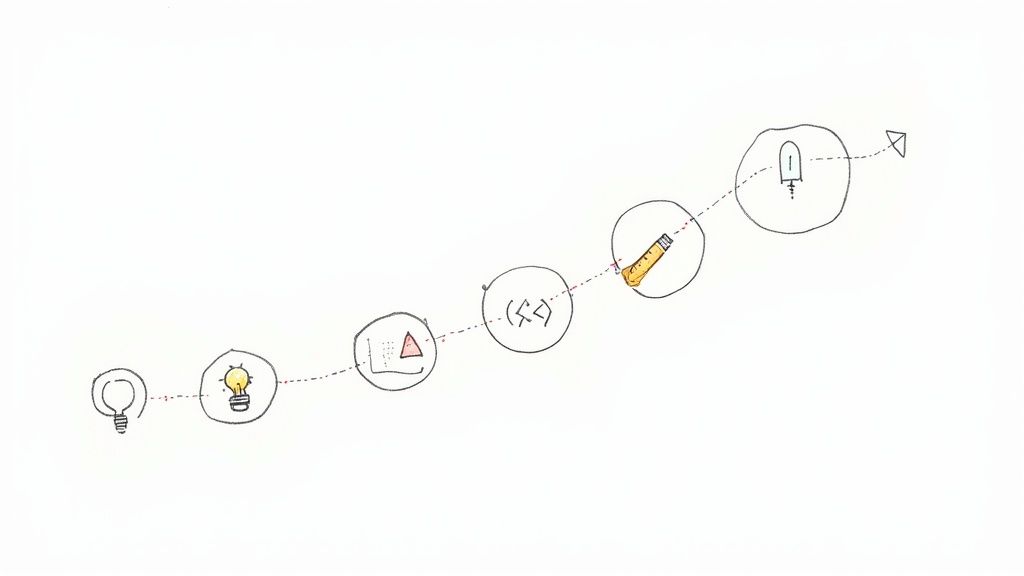
The diagram nails it: a tech spec is the bridge from a fuzzy idea, through that messy middle phase, to a clear, actionable plan. It's what turns concepts into code.
Let's walk through the key sections that make this template work. This table gives you a quick overview of what each part is designed to achieve.
Key Sections Of The Technical Specification Template
A breakdown of the essential components in our template and the critical question each section answers to ensure comprehensive project planning.
| Section Name | Purpose And Key Question Answered |
|---|---|
| Summary & Background | The elevator pitch. Why are we building this, and for whom? |
| Goals & Non Goals | Defines success and boundaries. What are we explicitly doing and NOT doing? |
| Assumptions & Dependencies | Lists external factors. What are we relying on that's outside our control? |
| Proposed Solution | The high level technical plan. How will the system work? |
| Data Models & Schema | The blueprint for your data. What information will we store and how? |
| API Endpoints | The contract for services. How will different parts of the system talk to each other? |
| Security Considerations | Protects users and the system. How are we keeping this secure? |
| Testing Plan | Ensures quality and correctness. How will we know it works? |
| Rollout & Monitoring Plan | Manages the launch and beyond. How will we release this and watch it in production? |
Each section builds on the last, creating a complete picture that prevents confusion and aligns the entire team.
The Foundational Components
Every solid tech spec starts with the same core elements. These sections are about setting the stage, defining the problem, and getting everyone on the same page before a single line of code gets written.
- Summary and Background: This is your elevator pitch. It needs to explain the problem you're solving and for whom, in a way that even a non technical stakeholder can understand in 60 seconds.
- Goals and Non Goals: You have to clearly state what success looks like, preferably with measurable outcomes. Just as important is defining what's explicitly out of scope. This section is your best defense against scope creep later on.
- Assumptions and Dependencies: What external factors or existing systems are you counting on? List them out. For example, "We assume the third party payment API can handle 100 transactions per second."
Getting this foundation right is non negotiable. You'll find that solid business analysis best practices, especially around gathering requirements, are absolutely critical here.
A spec without clear goals is like a ship without a rudder. You might be moving, but you have no idea if you're headed in the right direction. The 'why' gives the 'what' its purpose.
This structured approach isn't just a modern trend. Frameworks for rigorous documentation have been around for ages. The old IEEE 830 1998 standard is a perfect example; even though it's been superseded, its principles are so sound that people still reference it today. There's a reason for that: projects with clear, rigorous specs have way fewer cost overruns and delays.
The Technical Nitty Gritty
Once you've set the high level context, it's time to get into the details engineers need to actually start building. These sections are the beating heart of the technical specification.
- Proposed Solution and Architecture: This is where you draw the map. Include diagrams showing system components, data flows, and how they all interact. It doesn't need to be a work of art, but it has to be clear enough to explain the technical approach at a glance.
- Data Models and Schema: Define your database tables, fields, types, and their relationships. This is absolutely critical for backend engineers and helps prevent messy data structure conflicts down the line.
- API Endpoints: If you're building or changing any APIs, this is non negotiable. Specify the endpoint URL, HTTP method, request parameters, and provide examples for both success and error responses. If you need a refresher, our guide on unmissable API documentation best practices for 2025 is a great place to start.
The Supporting Cast
Finally, a truly complete tech spec covers everything around the code. People often overlook these sections, but they are vital for a smooth launch and painless long term maintenance.
- Security and Privacy Considerations: How are you handling authentication and authorization? What sensitive data is involved, and how will it be protected? You must answer these questions upfront.
- Testing Plan: Outline your testing strategy. This should cover unit tests, integration tests, and any manual QA steps. Most importantly, define what "done" means with clear acceptance criteria.
- Rollout and Monitoring Plan: How will this feature actually get deployed? Will it be a phased rollout or a big bang release? And once it's live, what metrics will you be watching to make sure it's working as expected?
By structuring your document this way, you create a single source of truth that serves everyone from product managers to the engineers who get paged at 3 AM.
Theory is great, but a template is just a skeleton. It only really comes alive when you throw a messy, real world problem at it. So, let's do exactly that.
We're going to take our technical specification template and use it to spec out a feature that's incredibly common in startups right now: a Retrieval Augmented Generation (RAG) system.
The mission is to build a smart Q&A bot for our product's documentation. A user asks a question, and our system digs up the relevant docs, then uses an LLM to generate a clean, helpful answer. This isn't some "hello world" example; it's a real feature with plenty of moving parts.
We'll walk through defining user stories, designing the Django backend models, specifying a critical REST API endpoint, and even outlining a Celery pipeline for document processing. This is where the rubber meets the road.
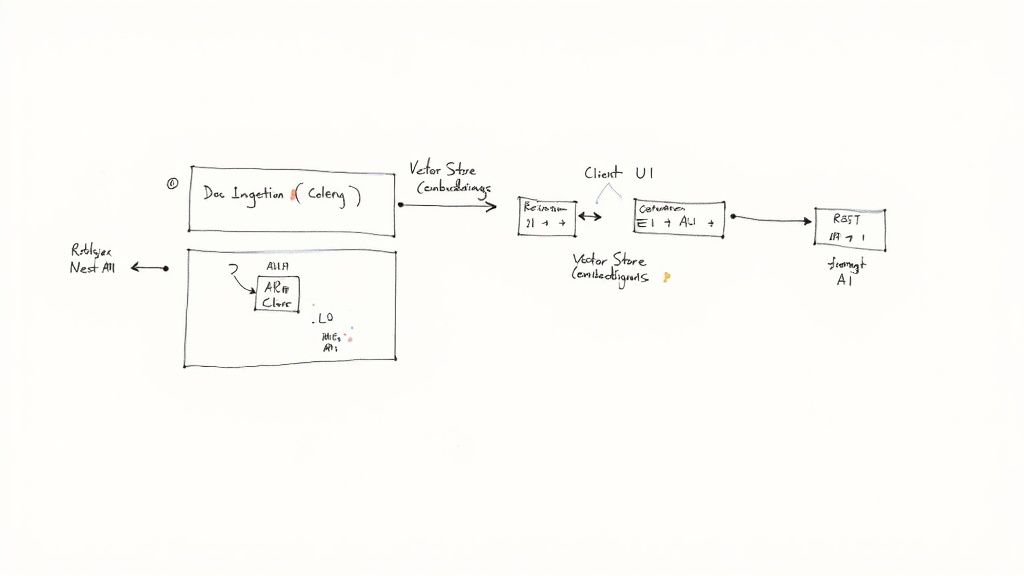
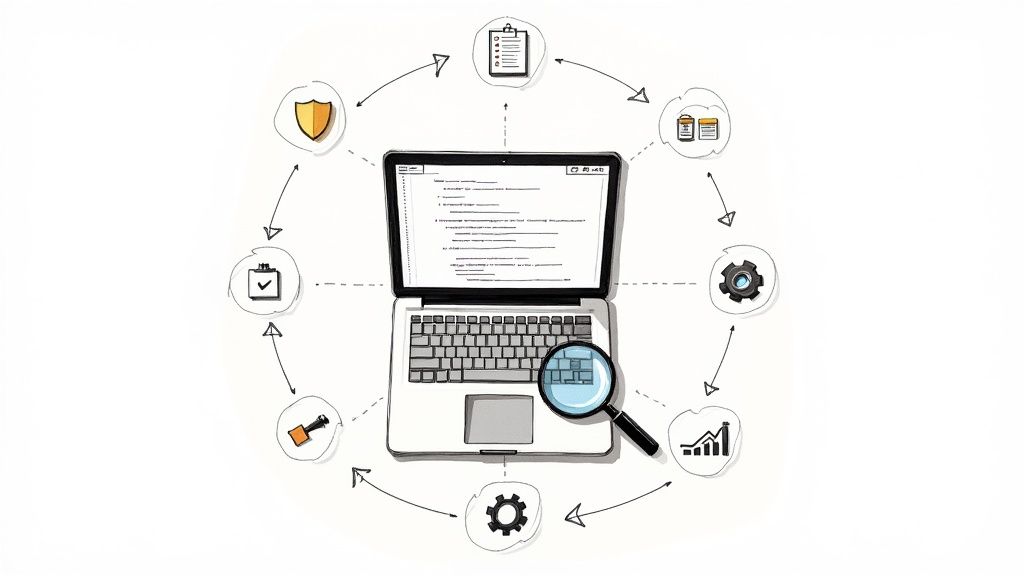
This diagram gives a high level look at a typical RAG pipeline. It shows the whole journey from ingesting documents to handing a final answer back to the user, hitting key components like vector databases and language models that we'll need to wire up.
By the time we're done, you'll see how the template turns abstract ideas into a solid engineering plan.
Setting The Scene: The RAG Q&A Bot
First things first, let's fill out the high level sections of the tech spec. This gives everyone on the team the context they need to understand the why behind the work.
Summary & Background
- Problem: Our users are getting lost in our extensive documentation. The keyword search we have now just isn't cutting it—it spits out irrelevant links, causing frustration and bogging down our support team.
- Proposed Solution: We're building an AI powered Q&A feature. Users can ask questions in plain English, and a RAG pipeline will retrieve the right info from our knowledge base to generate a direct, accurate answer, complete with links to the source docs.
Goals & Non Goals
- Goals:
- Cut down on support tickets related to documentation questions by 20% within three months.
- Hit a P95 API latency of under 2 seconds for all user queries.
- Have users find a satisfactory answer without navigating away in 70% of sessions.
- Non Goals (What we're NOT building in V1):
- Answering questions about a user's specific account or billing info.
- Remembering conversation history (every query will be stateless).
- Supporting any language other than English.
Defining non goals is a superpower. Seriously. It's the single best way to kill scope creep before it starts and keep the team focused. I've seen projects get derailed for months simply because this section was too vague.
Diving Into The Technical Details
Alright, now for the fun part. Let's translate those goals into a concrete technical plan using the next sections of our template.
Proposed Solution & Architecture
We'll build this feature right into our existing Django application. The architecture breaks down into three main components:
- Asynchronous Document Ingestion: A Celery pipeline will be responsible for periodically scraping our knowledge base. It will chunk the documents, generate embeddings via an API like OpenAI, and store everything in a vector database—something like Pinecone would be a good fit.
- Django REST Framework API: We'll create a new API endpoint to handle user questions. It will take a query, generate an embedding for it, hit the vector database for relevant document chunks, and then feed that context to an LLM to cook up the final answer.
- Next.js Frontend Component: A simple, chat like interface will be added to our documentation pages. This component will be the user's window into the backend API.
A quick sequence diagram helps make the flow crystal clear.
sequenceDiagram participant User participant Frontend (Next.js) participant Backend (Django) participant VectorDB participant LLM API
User->>Frontend: Submits question
Frontend->>Backend: POST /api/v1/qa/query
Backend->>VectorDB: Search for relevant docs
VectorDB-->>Backend: Return document chunks
Backend->>LLM API: Send prompt with context
LLM API-->>Backend: Generate final answer
Backend-->>Frontend: Return answer & sources
Frontend-->>User: Display answer
Visuals like this are worth their weight in gold in a tech spec. They communicate interactions between services way more effectively than a wall of text ever could.
Defining Data and API Contracts
With the architecture mapped out, it's time to get specific about the data structures and API contracts. This is where ambiguity goes to die.
Data Models (Django)
We'll need a new model to keep track of the documents we've processed from our knowledge base.
In knowledgebase/models.py
from django.db import models
class DocumentSource(models.Model): """Stores metadata about a document from our knowledge base.""" title = models.CharField(max_length=255) source_url = models.URLField(unique=True) content_hash = models.CharField(max_length=64, help_text="SHA256 hash of the content") last_processed_at = models.DateTimeField(auto_now=True) status = models.CharField( max_length=20, choices=[("PENDING", "Pending"), ("PROCESSED", "Processed"), ("FAILED", "Failed")], default="PENDING" )
def __str__(self):
    return self.title
API Endpoints (Django REST Framework)
This is the handshake between our frontend and backend. It needs to be precise.
- Endpoint:
POST /api/v1/qa/query - Authentication: JWT Required (the user must be logged in).
- Request Body (JSON):
{ "query": "How do I reset my password?" }
- Success Response (200 OK):
{ "answer": "To reset your password, navigate to the settings page and click 'Reset Password'. You will receive an email with further instructions.", "sources": [ { "title": "Managing Your Account", "url": "https://docs.example.com/account-management" } ] }
This level of detail eliminates any guesswork for the engineers. Everyone knows what "done" looks like.
This proactive approach is crucial, especially now. The 2025 technical documentation landscape is shifting fast, with personalization becoming a top priority for 73% of users, thanks in large part to their experiences with Generative AI. Building systems like this RAG bot directly meets that rising expectation. You can explore more insights on emerging documentation trends to see just how much AI is shaping what users want.
By filling out the technical specification template with this kind of detail, we've created a clear, actionable blueprint. The team now understands the why, the what, and the how, setting the stage for a much smoother development cycle.
Common Pitfalls And Lessons Learned The Hard Way
I've written some truly terrible tech specs in my day. I'm talking about the kind that are either so ridiculously vague they just create more questions, or so granularly detailed they become obsolete the second a developer types git commit. Both extremes are traps, and I've fallen into each one.
The most common mistake? Treating the technical specification template as a stone tablet handed down from the heavens. It's not. It's a map for a journey that will inevitably have detours. Clinging to the original document like it's sacred text is a recipe for disaster in any agile environment.
The Spec As A Living Document
The best specs I've ever worked with are living, breathing documents. They have to evolve as the team learns more, hits unexpected roadblocks, or uncovers a smarter way to build something. The goal isn't to predict the future perfectly; it's to start with a strong, shared understanding and adapt intelligently along the way.
A few tips to keep it alive:
- Version Control Everything: Keep your spec in a system like Confluence or, my personal favorite, as a Markdown file right in your Git repository. Track changes and add comments explaining why a decision was made. Future you will be grateful.
- Link to Tickets: Connect sections of the spec directly to the Jira or Linear tickets where the work is happening. This creates a two way bridge between the high level plan and the day to day execution.
- Do Regular Check Ins: Briefly review the spec during sprint planning or backlog grooming. Just ask the simple question, "Does this still reflect reality?"
A spec that hasn't been updated in two weeks is a historical artifact, not a useful tool. The moment it diverges from the implementation, it starts losing the team's trust.
This dynamic approach is what prevents the spec from becoming irrelevant, ensuring it remains the single source of truth throughout the project's lifecycle.
Avoiding The Gold Plating Trap
Another pitfall I know all too well is "gold plating." This is where you over engineer a solution on paper, designing for every conceivable edge case and future possibility before you've even validated the core idea. You end up with a spec for a Rolls Royce when all you really need is a reliable skateboard to get started.
This often stems from a fear of future refactoring. But in a startup environment, the future is radically uncertain. Building for a hypothetical problem that may never exist is a huge waste of time and money. The spec has to focus on the Minimum Viable Product (MVP) first and foremost.
Here's how to stay focused:
- Explicitly Define V1: Use the "Goals and Non Goals" section to be ruthless. State clearly, "For V1, we will only support X. We will explicitly NOT support Y or Z."
- Plan for Extensibility, Don't Build It: It's smart to design with the future in mind. For example, choose a data model that can be easily extended later. But don't actually build the extension until you need it.
- Ask "What's The Simplest Thing That Could Possibly Work?": This is a classic Extreme Programming mantra for a reason. Apply it to your spec. Challenge every complex component and ask if there's a simpler path to achieving the core goal.
This disciplined approach is also critical when you're evaluating existing systems or potential acquisitions. Over engineered solutions can hide massive amounts of technical debt. Having a sharp eye for these details is a key part of our technical due diligence checklist, which helps uncover those skeletons before they become your problem. By learning to avoid these common mistakes in your own documentation, you'll not only build better products but also develop a keener sense for spotting well architected systems out in the wild.
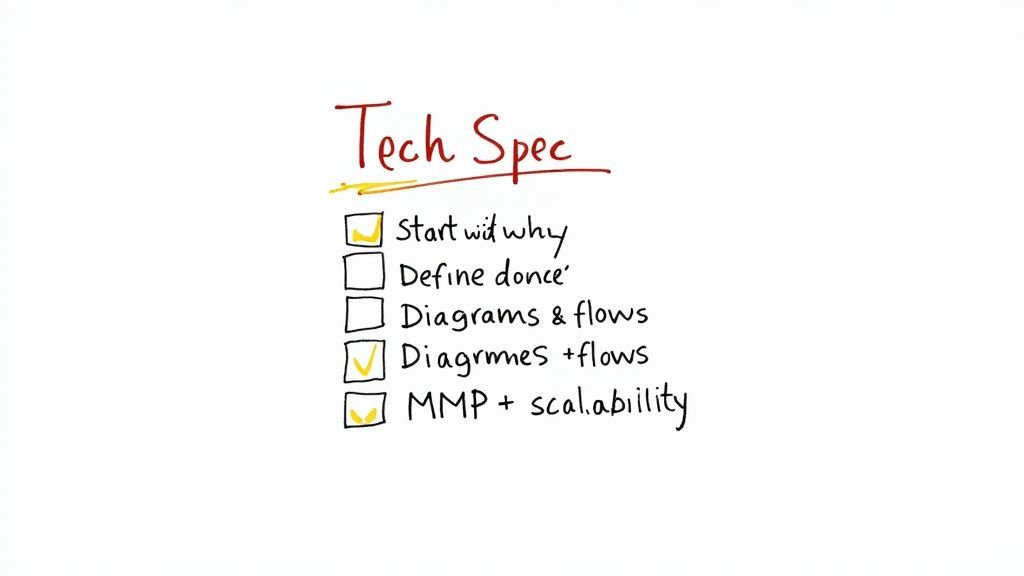
Alright, we've gone through a ton of detail, from the high level theory down to a full blown practical example. Let's pause and reflect. Let's boil all that down into a quick and dirty cheat sheet. This isn't just a recap; it's a mental model to help you bake great spec writing into your regular workflow, making it a habit, not a chore.
Think of this as your pre flight check before you hand a spec over to the team. A quick run through here can save you hours of confusion and rework down the line.
Key Takeaways
- Start with the 'Why': Before a single line of code is contemplated, nail down the problem. Seriously. If a new engineer can't read the first two paragraphs and tell you the business goal, your spec is broken.
- Define 'Done' Upfront: Vague acceptance criteria are your enemy. Be brutally specific about what success looks like. How will you know, for a fact, that this feature is working as intended in production? Define the metrics, the user visible outcomes, and the success signals.
- Collaborate, Don't Dictate: A tech spec is a conversation starter, not a stone tablet sent from on high. Pull in other engineers, your product manager, and designers as early as you can. Their perspective will expose blind spots you didn't even know you had.
- Visualize Complex Flows: A simple sequence diagram or a whiteboard style architectural sketch is worth a thousand words. Don't let ambiguity hide in dense paragraphs of text. Use visuals to make interactions between services or tricky user journeys crystal clear.
Look, the goal isn't to write a perfect, flawless document on the first attempt. The real goal is to forge a shared understanding that's clear enough for the team to start building with confidence.
A Practical Checklist to Download
To make this dead simple, I've put together a downloadable checklist you can grab. It's a straightforward list to run through before you hit 'publish' on that Confluence page or merge the Markdown file. It covers all the bases, from explicitly defining non goals to outlining your monitoring and alerting plan.
This checklist turns these abstract principles into concrete actions. It ensures your spec does its main job: aligning the team to build better software, faster. This mindset is especially crucial when you're planning bigger initiatives, much like you would when putting together a technical roadmap template that actually works. By internalizing these steps, you'll build the muscle for creating clear, effective specs every single time.
Frequently Asked Questions
Even with a great technical spec template, questions always come up. That's just the nature of trying to fit a structured process into the wonderfully messy world of software development. Let's dig into some of the most common ones I hear from teams trying to make this work.
Does a Detailed Spec Kill Agility?
This is the big one—the classic tug of war between planning and speed. The fear is that by writing a detailed spec, you're locking yourself into a rigid, waterfall style plan, which feels like the polar opposite of being agile. I used to think this way, too. Specs felt like an artifact from another era that had no place in a fast moving startup.
I was wrong. A good tech spec isn't a contract written in stone; it's a shared understanding captured on paper. It doesn't kill agility, it enables it.
Think about it. Real agility comes from being able to pivot quickly and confidently. You can't do that if you don't have a clear, collective understanding of your starting point. The spec serves as that baseline. When a new requirement drops or you learn something unexpected, you can go back to the document and ask smart questions like, "Okay, this change hits our API contract here and our data model here. What's the real impact?" Without that baseline, you're just guessing.
A tech spec in an agile world isn't about predicting the future. It's about making the present so clear that you can react to the future intelligently. It's your anchor, not your cage.
The trick is to treat it as a living document. It should evolve with every sprint. When a decision changes, the spec changes. This discipline keeps your documentation a source of truth, not a source of confusion.
How Much Detail Is Too Much Detail?
Finding that sweet spot for detail is more of an art than a science, and it really depends on your team's context. A crew of senior engineers who've worked together for years might need far less detail than a team with a few new junior members. The goal is always clarity, not writing a novel.
My rule of thumb is this: specify the what and the why, but leave flexibility on the how.
- Specify the "what": Be crystal clear about things like API contracts, data schemas, and user facing acceptance criteria. These are the interfaces between different parts of your system or between the system and its users. Any ambiguity here is a recipe for painful integration problems down the line.
- Specify the "why": Always, always include the background and goals. This context is gold; it empowers engineers to make better implementation choices when they run into something you didn't anticipate.
- Be flexible on the "how": Unless it's absolutely critical for performance or security, avoid dictating specific algorithms or class names. Give your engineers the autonomy to solve the problem in the way they see best.
You've gone too far when the spec starts micromanaging implementation details that have no impact on the system's external behavior. The document should guide, not handcuff.
How Do I Get My Team to Actually Use It?
Ah, the classic change management problem. You can't just drop a new template on your team and expect them to embrace it. I've seen that movie before, and it ends badly. The key is to demonstrate its value and make it a natural part of the workflow, not just another chore.
Here are a few tactics that have worked for me:
- Lead by Example: If you're a tech lead or senior engineer, you write the first few specs. Make them sharp, concise, and genuinely useful. When your team sees how a good spec cuts down on confusion and endless back and forth, they'll start seeing the light.
- Make it Collaborative: Don't write the spec in a silo. Grab a couple of engineers for a quick whiteboarding session to hash out the architecture. Make it a team activity. This creates shared ownership right from the get go.
- Integrate it into Your Process: Make the tech spec a non negotiable part of your "Definition of Ready." No major feature ticket gets pulled into a sprint without a linked and reviewed spec. It becomes a natural checkpoint, not an afterthought.
Getting buy in is about showing, not telling. Once the team feels the pain of not having a spec on a complex project, they'll be much more receptive to using one on the next.
Is a Full Spec Always Necessary?
Definitely not. A full blown technical spec is complete overkill for a small bug fix or a minor UI tweak. Using this template to change a button color is like using a sledgehammer to crack a nut. You have to right size the documentation to the complexity and risk of the change.
Here's a simple framework I lean on:
- High Risk / High Complexity: Think new microservice, major refactor, or a new public API. Use the full technical specification template. No shortcuts.
- Medium Risk / Medium Complexity: This could be adding a new field to an existing API or a new page with some business logic. A "mini spec" is often enough—maybe just a section in the Jira ticket covering the proposed change, data model tweaks, and the testing plan.
- Low Risk / Low Complexity: We're talking text changes, minor CSS fixes, or simple bug fixes. A clear ticket description is all you need. No formal spec required.
The whole point of a technical specification template is to reduce risk and create clarity where it's needed most. Applying it judiciously is just as important as knowing how to write it well. For a foundational understanding of what a template generally entails within a documentation system, you might refer to the explanation on What is a Template. It all comes down to using the right tool for the right job.
Subscribe to our newsletter.
Become a subscriber receive the latest updates in your inbox.
Member discussion