

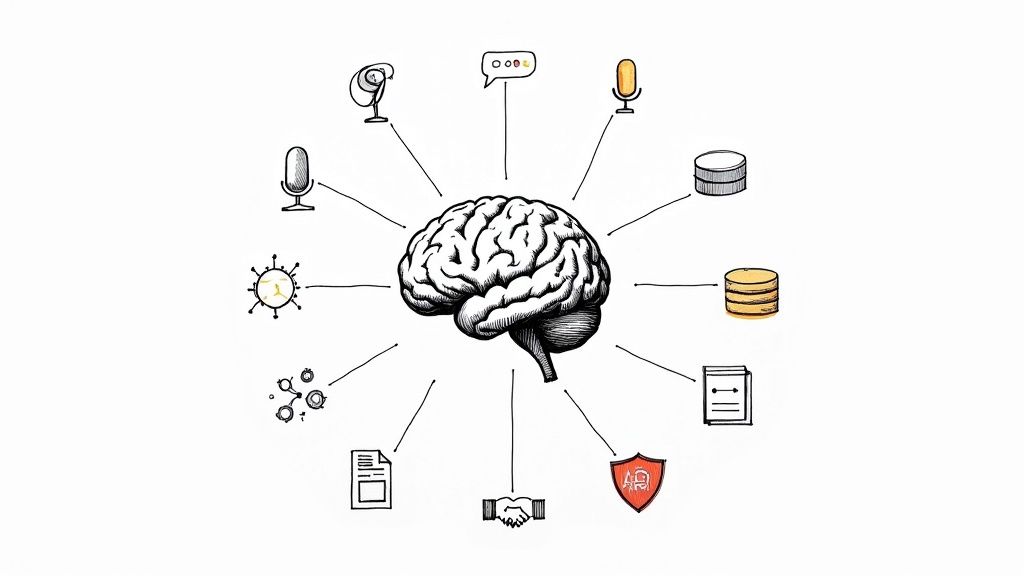
The customer support channel in our Slack was on fire. Not in a good way. Every notification was another ticket, another question, another user blocked. Our small team was spending half its day context switching between writing production grade code and answering the same three questions about API key permissions. We knew AI was the supposed answer, but the hype felt distant. It was all about futuristic AGI, not about solving our immediate, very human problem of being overwhelmed. The real question wasn't "what is the future of AI," but "what can we actually build with this stuff, right now, with a Django backend and a Next.js frontend?"
This article is for the engineering teams and founders asking that same question. It's not about abstract theories; it's a practical, actionable catalog of conversational ai use cases you can implement to solve real business bottlenecks. Forget the vague promises of "digital transformation." We're diving deep into twelve specific applications, from automating IT support to building intelligent ecommerce assistants that actually drive sales. For each use case, we will break down the business value, outline a typical architecture (including RAG and VoiceAI where relevant), and provide implementation guidance for your stack.
We'll discuss how to integrate these systems with tools you already use, like Celery for asynchronous tasks and Docker for deployment. More importantly, we'll explore the common pitfalls to avoid and the key metrics you need to track to prove success. This is your blueprint for moving from AI hype to tangible, valuable product features that give your team its time back and deliver a better experience for your users. Let's get building.
1. Customer Service Chatbots
As one of the most visible conversational AI use cases, customer service chatbots are the digital front line for countless businesses. Deployed on websites, in apps, and across messaging platforms, these AI systems handle a high volume of customer inquiries 24/7. Their primary function is to provide instant, automated responses to common questions, guide users through troubleshooting steps, and process routine service requests like order status checks or password resets.
This immediate, always on support significantly reduces operational costs by deflecting tickets that would otherwise require human intervention. More advanced chatbots, such as Bank of America's Erica or the Zendesk Answer Bot, leverage customer data for personalized interactions and can escalate complex issues to a human agent with full context, ensuring a seamless experience.
For startups and engineering teams, the key is to start small. Focus on automating the top 5 to 10 most frequent, low complexity queries. This strategy delivers the quickest return on investment and builds a solid foundation. An effective architecture often involves a Retrieval Augmented Generation (RAG) model, which pulls answers directly from your knowledge base, ensuring accuracy and relevance. For more details on this powerful technique, you can learn more about how RAG enhances chatbot intelligence.
Key Strategic Insights
- Business Value: Lowers support overhead, improves first response time, and increases customer satisfaction by offering instant resolutions.
- Implementation Tip: Begin by analyzing existing support ticket data to identify high volume, repetitive questions. This data driven approach ensures you're automating tasks with the highest impact.
- Success Metric: Track deflection rate (the percentage of queries resolved without human intervention) and customer satisfaction (CSAT) scores post interaction.
2. Healthcare Symptom Checkers and Diagnostic Assistants
In healthcare, conversational AI is becoming a crucial first point of contact for patients seeking information. Symptom checkers and diagnostic assistants are AI powered tools that guide users through a series of questions to assess their health concerns. Acting as a preliminary triage system, these applications analyze patient provided symptoms against vast medical knowledge bases to suggest potential conditions and recommend next steps, such as self care, a pharmacy visit, or seeing a doctor.

This digital first approach helps manage patient flow for healthcare providers and empowers individuals with accessible health information. Leading examples like Ada Health and Buoy Health have popularized this use case by offering sophisticated, user friendly interfaces that build patient trust. These systems not only assess symptoms but are increasingly used for ongoing patient monitoring and even documentation. For a deeper dive into how voice AI is transforming medical documentation, explore the specifics of medical voice charting.
For engineering teams entering this regulated space, the primary challenge is balancing utility with safety. The architecture must be built on a foundation of verified medical data and include aggressive escalation protocols for severe symptoms. While these tools are a powerful innovation in patient engagement, they are just one of many powerful artificial intelligence ideas ready for 2025 that are reshaping modern healthcare.
Key Strategic Insights
- Business Value: Reduces the burden on primary care services, improves patient access to health information, and provides valuable population health data (with user consent).
- Implementation Tip: Prioritize safety and compliance. Always include prominent disclaimers that the AI is not a substitute for professional medical advice and design conversation flows based on established clinical guidelines.
- Success Metric: Measure the appropriateness of care recommendation (did the AI correctly guide the user to the right level of care?) and user engagement rates.
3. Ecommerce Shopping Assistants
Ecommerce shopping assistants are a prime example of conversational AI use cases that directly drive revenue by mimicking the helpfulness of an in store sales associate. These AI agents are integrated into online retail platforms to guide customers through product discovery, provide personalized recommendations, and simplify the checkout process. By understanding natural language queries like "show me black running shoes for under $100," they create a more intuitive and engaging shopping journey.
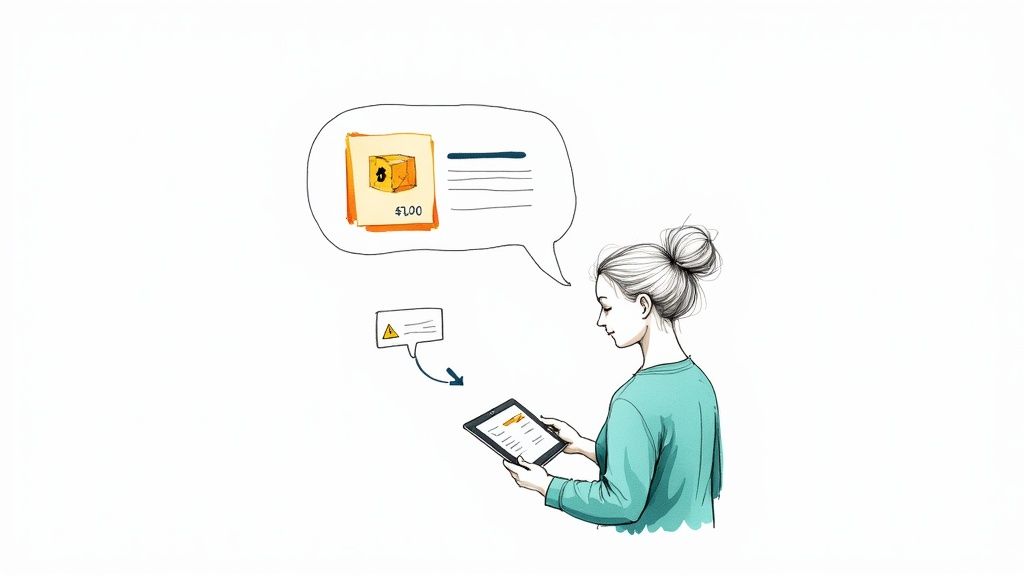
This approach transforms static product catalogs into dynamic, interactive experiences. Leading brands like Sephora use their Virtual Artist to offer tailored product suggestions, while H&M's chatbot provides style recommendations, effectively boosting user engagement and conversion rates. For engineering teams, the goal is to augment the existing search functionality, not replace it, by handling more nuanced and preference based queries. A common architecture involves a recommendation engine powered by user browsing history and purchase data, feeding suggestions into a natural language interface. This creates a powerful conversational commerce channel that feels both personal and efficient, reducing cart abandonment and increasing average order value.
Key Strategic Insights
- Business Value: Increases conversion rates, raises average order value (AOV) through upselling and cross selling, and improves customer loyalty with personalized experiences.
- Implementation Tip: Start by integrating the assistant with your existing product catalog and user data APIs. Personalize recommendations based on a user's real time browsing history and past purchase data for maximum relevance.
- Success Metric: Monitor conversion rate from chatbot interactions, average order value (AOV) for users who engage with the assistant, and cart abandonment rate.
4. HR and Recruiting Chatbots
In the high stakes world of talent acquisition and employee management, conversational AI serves as a powerful force multiplier for HR teams. HR and recruiting chatbots are deployed across the entire employee lifecycle, from initial candidate screening to ongoing employee support. Their core purpose is to automate repetitive, time consuming tasks like scheduling interviews, answering frequently asked policy questions, and guiding new hires through onboarding.
This automation frees up HR professionals to focus on strategic initiatives like talent development and building company culture. Advanced systems, such as Paradox's Olivia or IBM Watson Recruitment, go beyond simple Q&A. They can engage candidates in natural conversations, screen qualifications against job requirements, and even help mitigate unconscious bias in the initial screening phase, making them a key part of modern conversational AI use cases.
For engineering teams looking to implement this, the ideal starting point is automating the candidate qualification and interview scheduling process. Integrating with your existing Applicant Tracking System (ATS) and HR Information System (HRIS) is crucial for a seamless data flow. A well trained model can handle initial screening questions, ensuring only qualified candidates reach the human recruiters, dramatically improving efficiency.
Key Strategic Insights
- Business Value: Reduces time to hire, increases recruiter productivity, improves candidate experience with instant communication, and ensures consistent application of HR policies.
- Implementation Tip: Begin by mapping your most frequent candidate and employee queries. Integrate directly with your company's ATS and calendar systems to automate scheduling, a common bottleneck.
- Success Metric: Track time to fill (the number of days from a job opening to a signed offer), candidate satisfaction scores, and the percentage of HR queries automated.
5. Financial Services and Banking Advisors
In the highly regulated world of finance, conversational AI is emerging as a powerful tool to democratize access to banking services and financial guidance. These AI advisors, deployed within banking apps and on investment platforms, assist users with a wide range of tasks, from checking account balances and executing trades to providing personalized spending analyses and initial investment recommendations. They function as always available virtual tellers and entry level financial guides.
This level of automation makes financial services more scalable and accessible, educating customers and helping them make more informed decisions. Prominent examples include Bank of America's Erica, which offers proactive insights and guidance, and Capital One's Eno, which helps users manage their money through simple conversation. These systems blend transactional capabilities with advisory functions, building user confidence through secure, data driven interactions.
For engineering teams, the paramount concern is security and compliance. The architecture must prioritize robust authentication and create immutable audit trails for every interaction and piece of advice given. Integrating these AI systems with predictive models can also help identify savings opportunities or flag unusual spending patterns, adding significant value. For a deeper look into this, you can explore our guide to predictive analysis and machine learning.
Key Strategic Insights
- Business Value: Increases customer engagement and financial literacy, drives adoption of digital banking products, and provides scalable, low cost financial guidance.
- Implementation Tip: Work hand in hand with compliance and legal teams from day one. Build strict guardrails and conversation flows that prevent the AI from giving unauthorized financial advice and clearly state its limitations.
- Success Metric: Monitor user engagement rates (how often users interact with the advisor), task completion rates for financial transactions (e.g., transfers, payments), and customer retention.
6. Legal Services and Contract Analysis Assistants
Among the most specialized conversational AI use cases, legal assistants are transforming one of the oldest professions. These AI tools streamline document review, analyze complex contracts for risks or specific clauses, and accelerate legal research. They function as a force multiplier for law firms and in house legal teams, automating the painstaking process of sifting through thousands of pages to find critical information, which dramatically reduces billable hours spent on tedious, low value tasks.
This automation allows legal professionals to focus on high level strategy and client counsel rather than manual data extraction. Advanced platforms like LawGeex or Evisort can review a Non Disclosure Agreement in minutes, flagging non standard clauses that would take a human lawyer significantly longer. Similarly, JPMorgan Chase famously deployed its COIN platform to analyze commercial loan agreements, a task that previously consumed 360,000 hours of lawyer time annually.
For engineering teams looking to enter this space, the initial focus should be on highly structured, lower risk documents like NDAs or standard sales contracts. A robust architecture would use a Retrieval Augmented Generation (RAG) model trained on a curated corpus of legal documents and firm specific playbooks. This ensures the AI's analysis is not only fast but also aligned with established legal standards and organizational policies, while always keeping a human lawyer in the loop for final validation.
Key Strategic Insights
- Business Value: Radically reduces time and costs for due diligence, contract review, and legal research. Increases accuracy and consistency in document analysis.
- Implementation Tip: Start by building a model to analyze a single, high volume contract type. Partner closely with legal experts to create a "gold standard" dataset for training and validation, and always maintain a human in the loop workflow for final approval.
- Success Metric: Measure time to review (the average time saved per document compared to manual review) and clause detection accuracy (the percentage of critical clauses correctly identified by the AI).
7. Education and Tutoring Assistants
Beyond customer support, conversational AI use cases are transforming education by creating personalized learning experiences. Education and tutoring assistants act as on demand tutors, offering homework help, explaining complex concepts, and engaging students 24/7. These systems adapt to individual learning paces, providing instant feedback and reinforcing knowledge through interactive dialogue.

This approach makes high quality tutoring more accessible and scalable. Leading examples like Duolingo's Max for language learning or Carnegie Learning's MATHia platform demonstrate how AI can guide students through difficult subjects. These tools don't just provide answers; they prompt students with questions and scaffold their learning process, fostering deeper understanding and critical thinking skills.
For engineering teams, building these systems requires a focus on pedagogy as much as technology. A robust architecture might use a Retrieval Augmented Generation (RAG) model trained on a curated curriculum and educational materials. The key is to design interactions that encourage learning rather than cheating. This involves implementing safeguards, tracking student comprehension through their responses, and adapting the difficulty level in real time.
Key Strategic Insights
- Business Value: Increases student engagement, provides scalable personalized learning, and offers valuable analytics to educators on student performance and common knowledge gaps.
- Implementation Tip: Partner with educators to design the learning conversations. Focus on a narrow subject area first, ensuring the AI can explain concepts in multiple ways based on student interaction.
- Success Metric: Measure student proficiency gain (pre and post assessment scores), session engagement time, and concept mastery rates as tracked by the system.
8. Travel and Hospitality Booking Assistants
Conversational AI is transforming how we plan and book travel, acting as a personal concierge in your pocket. These AI assistants help customers navigate the complex landscape of flights, hotels, and activities, moving beyond simple search queries to handle multi step booking processes. Deployed within messaging apps, on websites, or via voice assistants, they offer personalized recommendations based on user preferences, budget constraints, and even past travel history.
This level of intelligent automation streamlines the booking experience, significantly improving conversion rates and customer satisfaction. Leading examples, such as the assistants from Expedia and Kayak, can manage intricate requests like finding a pet friendly hotel with a pool within a specific budget. KLM's BlueBot even handles flight changes and provides boarding passes, demonstrating how these conversational AI use cases can manage the entire travel lifecycle, from initial planning to post trip support.
For engineering teams, the power lies in integrating real time data APIs for flights, hotels, and rental cars. The core challenge is managing complex state and user constraints (e.g., "Find me a flight to NYC after 5 PM but under $300"). An effective architecture often combines a powerful Large Language Model for understanding natural language with structured API calls to live inventory systems, ensuring the information provided is always accurate and bookable.
Key Strategic Insights
- Business Value: Increases booking conversion rates, enhances customer loyalty through personalized service, and reduces the burden on human agents for routine booking inquiries.
- Implementation Tip: Start by focusing on a single vertical, like hotel bookings. Integrate with a robust Global Distribution System (GDS) or aggregator API to access real time inventory and pricing data. Focus on handling a core set of filters like price, location, and amenities first.
- Success Metric: Monitor the look to book ratio (the percentage of searches that result in a completed booking) and task completion rate for multi step booking processes.
9. Internal IT Support and Knowledge Management
Turning conversational AI inward is a powerful strategy for boosting organizational efficiency. Internal IT support and knowledge management chatbots act as a first line of defense for employee queries, handling everything from password resets and software access requests to troubleshooting common technical glitches. Deployed on platforms like Slack or Microsoft Teams, these bots provide instant, 24/7 assistance, freeing up human IT staff to focus on more complex, strategic initiatives.
This self service model significantly reduces the internal ticket queue and empowers employees to resolve issues independently, minimizing downtime. Leading enterprise platforms like ServiceNow and Microsoft have popularized this approach, offering virtual agents that integrate directly into existing IT service management (ITSM) workflows. By providing immediate answers to policy questions or guiding users to the right documents in a vast knowledge base, these AI assistants become a central nervous system for internal information.
For engineering teams, this is a prime opportunity to apply conversational AI to solve a direct, internal pain point. An effective architecture often starts with a Retrieval Augmented Generation (RAG) model connected to the company's internal documentation, wikis, and IT ticket history. The system must also be designed for scalability and reliability, principles you can explore further by reading about top microservices architecture best practices for 2025.
Key Strategic Insights
- Business Value: Slashes internal support costs, improves employee productivity by reducing resolution times, and ensures consistent, accurate information delivery.
- Implementation Tip: Analyze historical IT support tickets to identify the most frequent and repetitive employee requests. Automating these high volume, low complexity issues first will demonstrate immediate value and build momentum for the project.
- Success Metric: Monitor the ticket deflection rate (how many issues are solved without human help), average resolution time, and internal employee satisfaction scores.
10. Manufacturing and Maintenance Support Assistants
On the factory floor, where uptime is measured in millions of dollars, conversational AI is becoming an indispensable tool for operational resilience. Manufacturing and maintenance support assistants are specialized AI systems designed to guide technicians through complex repairs, diagnostics, and safety protocols. Deployed on rugged tablets, smart glasses, or voice activated terminals, these assistants provide instant access to technical manuals, schematics, and expert knowledge, directly at the point of need.
This immediate, hands free support dramatically reduces equipment downtime and improves first time fix rates. Instead of leaving a machine to find a manual or consult a senior engineer, a technician can simply ask the AI for step by step instructions, troubleshooting guidance, or safety warnings. Platforms from industrial giants like Siemens and ABB integrate these AI assistants with IoT sensor data, enabling predictive maintenance alerts and proactive issue resolution before a critical failure occurs.
For engineering teams entering this space, the initial focus should be on the most critical or failure prone machinery. An architecture combining VoiceAI for hands free interaction with a Retrieval Augmented Generation (RAG) model is highly effective. The RAG system can pull precise information from vast libraries of technical documentation, maintenance logs, and schematics, ensuring the guidance provided is both accurate and contextually relevant to the specific piece of equipment being serviced.
Key Strategic Insights
- Business Value: Reduces costly equipment downtime, accelerates technician training and onboarding, improves safety compliance, and enhances overall equipment effectiveness (OEE).
- Implementation Tip: Start by digitizing maintenance logs and technical manuals for one critical production line. Use this focused dataset to train and validate your initial AI assistant, proving value quickly.
- Success Metric: Track Mean Time To Repair (MTTR) to measure the reduction in repair times and monitor First Time Fix Rate to see how often technicians resolve issues on the first attempt with AI assistance.
11. Real Estate and Property Management Assistants
Navigating the real estate market is notoriously complex, making it a prime area for conversational AI to add value. These AI assistants, integrated into property websites and management portals, streamline the entire journey for renters, buyers, and property managers. They answer questions about listings 24/7, schedule viewings, prequalify leads, and handle routine tenant communications like maintenance requests or rent payment queries. This automation frees up human agents to focus on high value, relationship driven tasks.
Industry leaders like Zillow and Apartments.com use AI to power conversational search, helping users find properties by describing their needs in natural language. Similarly, platforms like Rently use AI to automate the entire self touring process. For property managers, tools from companies such as AppFolio use AI to manage tenant communications and automate workflows, improving operational efficiency and tenant satisfaction. This is one of the more powerful conversational AI use cases for transforming a traditionally high friction industry.
For startups entering this space, the initial focus should be on creating a hyperlocal, data rich experience. An architecture built on Retrieval Augmented Generation (RAG) is highly effective here, allowing the AI to pull precise, up to date information from MLS listings, neighborhood data, and property databases. This ensures the assistant provides accurate and contextually relevant recommendations, from school district ratings to local market trends.
Key Strategic Insights
- Business Value: Increases lead qualification efficiency, reduces agent workload, and enhances the property search experience for consumers, leading to higher engagement and conversion.
- Implementation Tip: Begin by integrating with a reliable property data feed (like an MLS) and focus on answering the top 20 most common questions from prospective buyers or renters. Ensure seamless handoff to a human agent with full conversational context.
- Success Metric: Monitor lead to tour conversion rate and agent response time for inquiries handled by the AI. For property management, track the reduction in routine support tickets.
12. Food and Restaurant Ordering/Delivery Assistants
Conversational AI is transforming how customers interact with restaurants and delivery services, creating a more seamless and personalized ordering process. These AI assistants, integrated into apps, websites, and even drive thru systems, handle everything from taking complex orders with natural language to offering smart menu recommendations. They streamline operations by automating a critical, often time consuming touchpoint, allowing customers to place orders, customize items, and track deliveries without human intervention.
Platforms like UberEats and DoorDash use this technology to enhance search and provide personalized suggestions based on past orders and user preferences. Similarly, major chains such as Starbucks and McDonald's deploy AI to manage high volumes of orders with greater accuracy and speed. The food and restaurant industry is also seeing significant innovation, such as with AI powered voice agents revolutionizing restaurants in their phone and drive thru systems. This application of conversational AI directly boosts order value and operational efficiency.
For engineering teams, the implementation should focus on tight integration with real time inventory and point of sale (POS) systems. A Natural Language Understanding (NLU) model is crucial for accurately parsing complex orders with modifications and dietary needs. Connecting this to a recommendation engine that leverages user data can create a powerful, personalized experience that drives repeat business.
Key Strategic Insights
- Business Value: Increases order accuracy, reduces wait times, and boosts average order value through intelligent upselling and personalized recommendations.
- Implementation Tip: Integrate directly with inventory management APIs to prevent customers from ordering out of stock items. Use past order data to pre populate suggestions for repeat customers, simplifying their experience.
- Success Metric: Monitor order completion rate (percentage of initiated conversations that result in a placed order) and average order value (AOV) for interactions handled by the AI.
12 Conversational AI Use Cases Comparison
| Solution | Implementation Complexity | Resource Requirements | Expected Outcomes | Ideal Use Cases | Key Advantages |
|---|---|---|---|---|---|
| Customer Service Chatbots | Low to Medium | NLU models, CRM/KB integration, chat logs | Reduced support costs; faster responses; higher FCR | High volume, repetitive inquiries; tier 1 support | 24/7 availability; scalable; consistent responses |
| Healthcare Symptom Checkers & Diagnostic Assistants | High | Medical knowledge bases, clinical validation, legal/compliance (HIPAA) | Better triage; reduced unnecessary ER visits; patient education (not definitive diagnosis) | Preliminary triage; symptom assessment; patient guidance | Risk stratification; 24/7 accessibility; clinical guidance support |
| Ecommerce Shopping Assistants | Medium | Product catalog, personalization data, inventory & payment integration | Increased AOV; lower cart abandonment; higher engagement | Product discovery; personalized recommendations; mobile commerce | Personalized recommendations; conversion lift; smoother checkout |
| HR & Recruiting Chatbots | Medium | ATS/HRIS integration, candidate data, bias audits | Shorter time to hire; improved candidate experience; admin savings | Resume screening, interview scheduling, onboarding automation | Standardized screening; administrative efficiency; 24/7 candidate engagement |
| Financial Services & Banking Advisors | Very High | Secure banking systems, compliance framework (SEC/FINRA), strong security | Improved customer engagement; scalable advice; reduced support costs (with compliance limits) | Account servicing, routine financial guidance, transaction help | Personalized financial support at scale; continuous availability (regulated) |
| Legal Services & Contract Analysis Assistants | High | Legal corpora, attorney oversight, DMS integration, data protection | Faster document review; lower review cost; increased consistency | Contract review, clause extraction, due diligence | Rapid contract analysis; cost and time savings for routine tasks |
| Education & Tutoring Assistants | Medium to High | Subject content, adaptive learning models, LMS integration | Improved learning outcomes; 24/7 tutoring access; reduced teacher workload | Personalized tutoring, homework help, practice exercises | Adaptive instruction; progress tracking; scalable tutoring |
| Travel & Hospitality Booking Assistants | Medium to High | Booking APIs/GDS, real time pricing, payment & loyalty integration | Higher booking conversion; simplified itinerary planning | Multi leg bookings, concierge services, travel planning | Handles complex bookings; personalized recommendations; 24/7 support |
| Internal IT Support & Knowledge Management | Low to Medium | Knowledge base, ITSM integration (ServiceNow), access controls | Fewer IT tickets; faster resolutions; productivity gains | Password resets, common troubleshooting, onboarding support | Ticket reduction; consistent internal answers; faster employee support |
| Manufacturing & Maintenance Support Assistants | High | IoT/sensor integration, domain expertise, safety validation | Reduced downtime; predictive maintenance; improved safety compliance | Equipment troubleshooting, maintenance guidance, incident reporting | Uptime improvement; predictive alerts; supports less experienced technicians |
| Real Estate & Property Management Assistants | Medium | Property listings/MLS, images/3D, PM software integration, payments | Faster matching; reduced vacancies; improved tenant service | Property search, maintenance requests, tenant communications | Better property matching; 24/7 tenant support; streamlined operations |
| Food & Restaurant Ordering/Delivery Assistants | Medium | Menu/inventory integration, POS/delivery APIs, payment security | Higher order value; fewer ordering errors; improved delivery tracking | Conversational ordering, dietary accommodations, repeat orders | Conversational ordering; personalization; order accuracy |
So, What's Your Next Conversation?
We've journeyed through a dozen distinct conversational AI use cases, from the front lines of customer service to the complex machinery of manufacturing floors. The common thread isn't just the sophisticated technology like RAG or VoiceAI; it's the fundamental shift from users clicking through interfaces to users having a dialogue. The most powerful applications we explored weren't just about answering questions. They were about anticipating needs, streamlining workflows, and creating a more humane, efficient interaction with technology.
If you take away nothing else from this deep dive, let it be this: successful conversational AI is born from empathy, not just algorithms. It starts with a genuine understanding of a user's pain point, a moment of friction in their day, and asks, "Could a simple conversation make this better?" Whether it's a customer stuck on a support page or an engineer needing a maintenance protocol, the goal is the same: provide the right information, at the right time, in the most natural way possible. This focus on the user's journey is what separates a gimmicky chatbot from a truly transformative product feature.
Key Lessons from the Trenches
Reflecting on the architectures, pitfalls, and metrics we've dissected, a few core principles emerge. Keep these in your back pocket as you begin to map out your own implementation.
- Start Small, Win Big: Resist the urge to build an all knowing oracle. Your first version should solve one specific, high value problem exceptionally well. A focused HR bot that only handles leave requests is infinitely more valuable than a generic one that fails at everything.
- Design for Handoff: No AI is perfect. The smartest systems know their limits and provide a seamless, graceful handoff to a human agent. This isn't a sign of failure; it's a hallmark of a robust, user centric design. Your success metrics should account for smooth escalations.
- Your Data is Your Moat: The quality and structure of your internal knowledge base, whether it's for a RAG system or a diagnostic assistant, will be your single biggest competitive advantage. Clean, well organized, and relevant data is the fuel for any great conversational AI system. Invest in it early and often.
- Architecture Follows Function: Don't choose RAG or a fine tuned model because it's trendy. Let the use case dictate the architecture. A simple Q&A system might not need a complex vector database, while a diagnostic tool for healthcare will demand it. The right tool for the right job saves immense engineering pain down the road.
From Blueprint to Build
The journey from identifying a compelling use case to deploying a production grade AI feature can feel like navigating a maze. You'll encounter trade offs between latency and accuracy, wrestle with container orchestration in Docker, and debug asynchronous tasks managed by Celery. It's a path filled with both "aha!" moments and late night head scratchers. But as we've seen across all these examples, the potential ROI is massive, transforming user engagement and operational efficiency.
The ultimate question is no longer if you should implement conversational AI, but where you should start. Look at your own product, your own team, your own customers. Where is the friction? Where do people get stuck? Your next breakthrough feature is waiting there, hidden inside a conversation.
Navigating the complexities of building and scaling these conversational AI use cases requires both strategic vision and deep technical expertise. If you're looking to turn these ideas into production ready reality, Kuldeep Pisda offers specialized consulting and development services to help you architect, build, and deploy robust AI features. Explore how we can help your team at Kuldeep Pisda.
Subscribe to our newsletter.
Become a subscriber receive the latest updates in your inbox.

Member discussion