

Our Django application sailed smoothly through development. But deploying it felt like trying to conduct a chaotic orchestra with a broken baton. Services were out of sync, scaling was a nightmare, and observability was a black hole. It was one of those moments where you realize the map is not the territory. This painful experience sent me deep into the world of container management, searching for the best container orchestration tools that could bring harmony to our production environment. We needed a system that could not only manage containers but also handle the complex demands of our future workload, including GenAI and voice AI features.
This is not just another list. It's a map forged from late nights and production alerts, designed to guide you through the critical trade offs between simplicity, power, and cost. We will move past the marketing copy and dive into the practical realities of running these platforms. The goal is to help you select the right conductor for your specific application, whether you are building a high traffic API, a complex data pipeline, or a cutting edge AI service. A key benefit of container orchestration is its ability to scale applications efficiently; this capability fundamentally relies on robust network scalability to handle increasing traffic without performance degradation.
This guide provides an honest assessment of each tool, from the industry standard Kubernetes and its managed cloud derivatives like GKE and EKS to simpler, elegant alternatives like Nomad. For each option, we provide in depth analysis, screenshots, and direct links to help you make a decision that fits your team's size, budget, and technical expertise. We will explore pros, cons, operational complexity, and specific use cases, ensuring you find the best container orchestration tools to prevent your own deployment symphony from falling apart.
1. Kubernetes (upstream, open source)
For teams wanting complete control and a deep understanding of container orchestration, going directly to the source, kubernetes.io, is the definitive starting point. This is not a managed service or a commercial product; it's the home of the vendor neutral, CNCF hosted open source project that powers nearly every other platform on this list. Think of it as the raw, powerful engine before a car manufacturer puts a chassis and luxury features around it. This makes it one of the best container orchestration tools for purists and those building custom platforms.
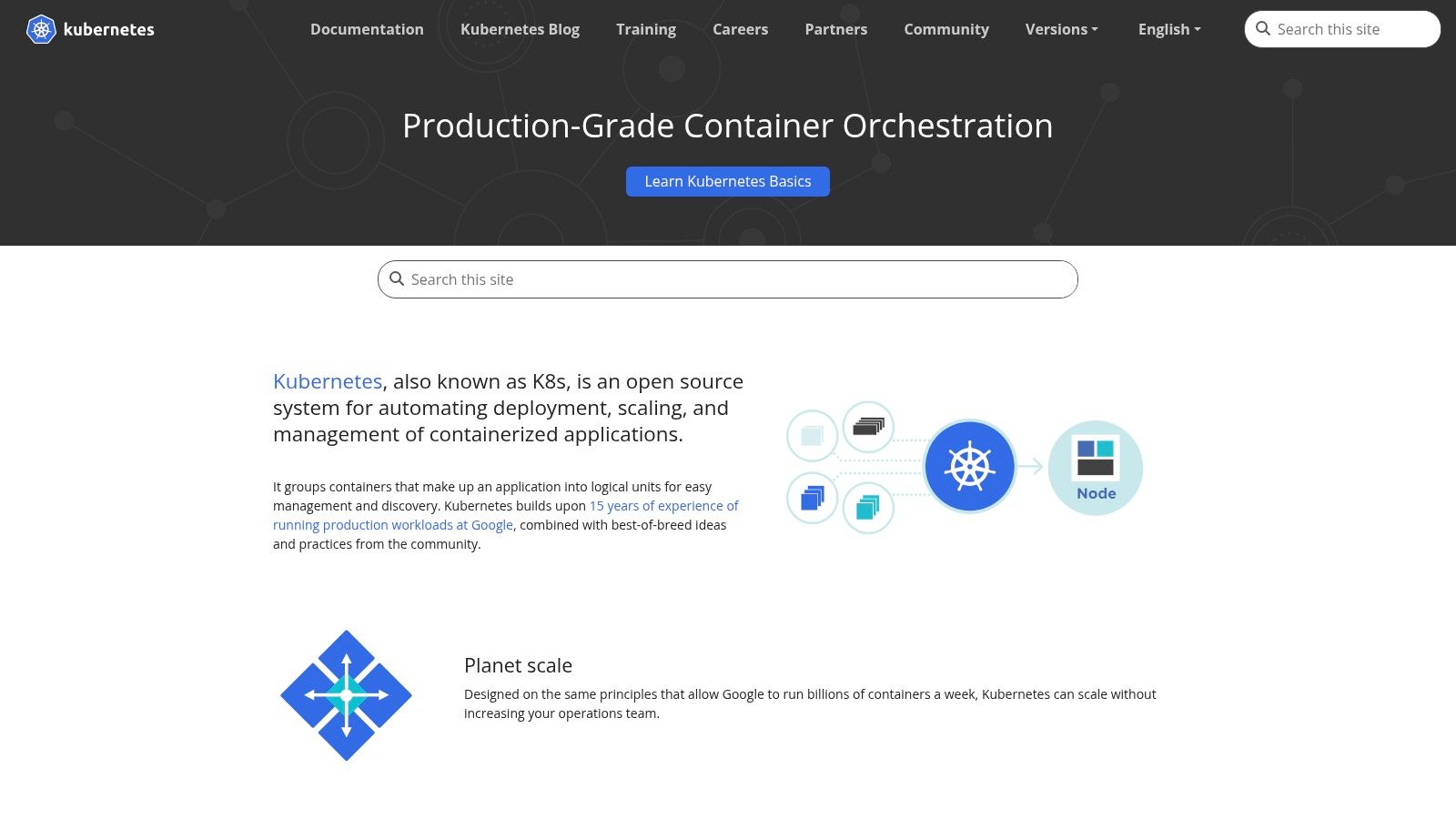
The primary value of the site is its exhaustive documentation, tutorials, and direct access to releases. For startups with strong DevOps talent, self managing Kubernetes offers maximum flexibility and zero vendor lock in. However, this freedom comes at the price of operational complexity. You are solely responsible for setting up, securing, and maintaining the control plane, managing upgrades, and ensuring high availability. It is a significant undertaking but provides unparalleled insight into the system's inner workings. For a foundational understanding, especially if you are new to containers, it is helpful to first get comfortable with Docker. To help with that, explore this in depth guide on Docker setup.
Key Considerations:
- Best For: Teams with deep infrastructure expertise wanting to build a bespoke platform or avoid vendor lock in. Ideal for complex, multi cloud or on premises deployments.
- Pros: Completely free (open source), largest possible ecosystem of tools and community support, and the ultimate in flexibility and control.
- Cons: Extremely high operational overhead. Requires a dedicated team to manage production grade clusters, including security, upgrades, and reliability.
Website: https://kubernetes.io
2. Amazon Elastic Kubernetes Service (EKS)
For teams already invested in the AWS ecosystem, Amazon EKS presents a highly integrated and powerful path to production grade Kubernetes. EKS is a managed service that simplifies running Kubernetes on AWS without needing to install, operate, and maintain your own control plane. It provides the flexibility of Kubernetes with the deep integration and reliability of AWS infrastructure, making it one of the best container orchestration tools for businesses scaling on the cloud. This approach offloads the immense operational burden of managing the Kubernetes masters, letting your team focus on deploying and managing applications.
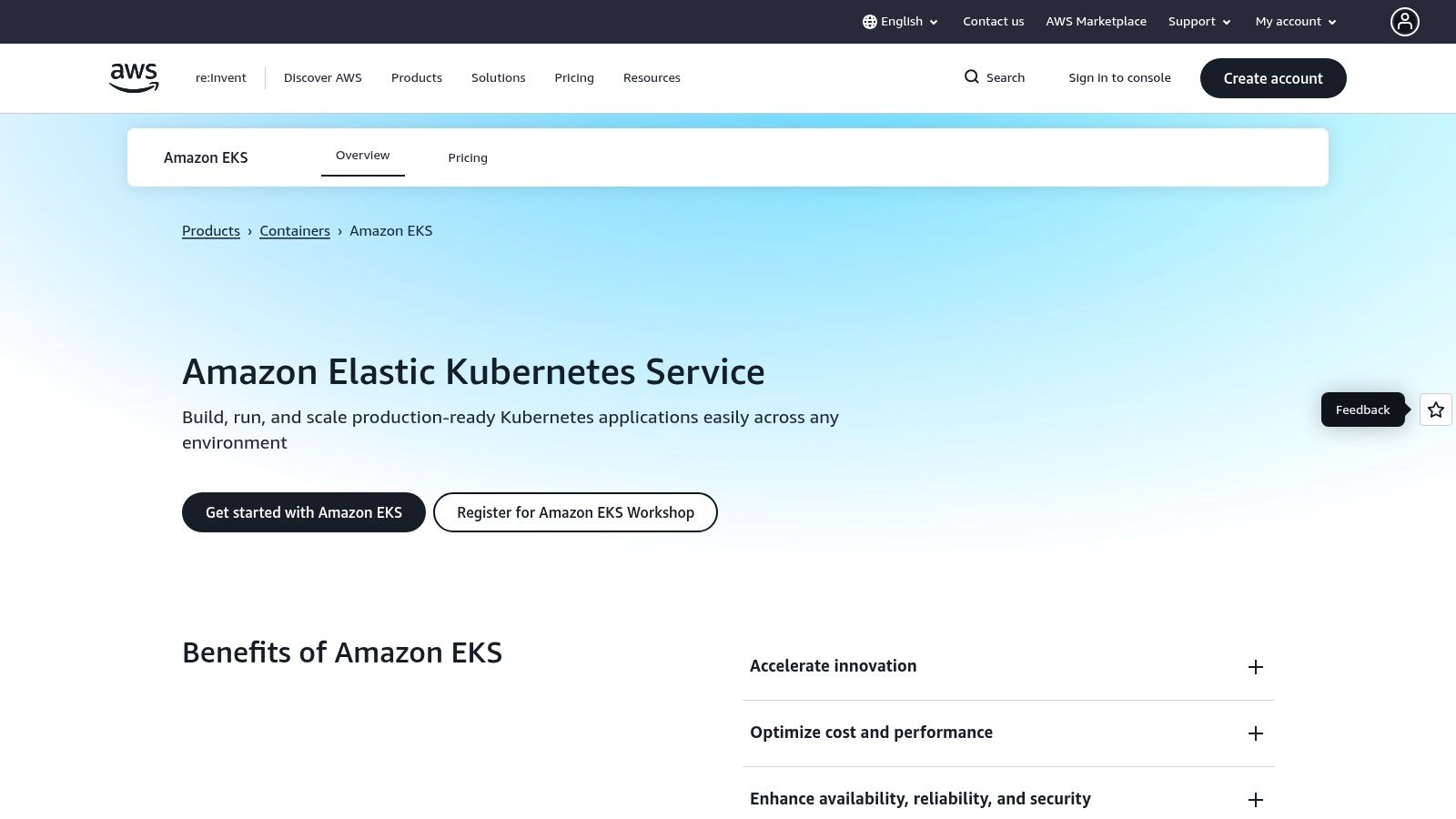
The platform is designed for enterprise workloads, offering a financially backed SLA and a clear version support lifecycle. Its standout feature is the seamless integration with other AWS services like IAM for authentication, VPC for networking, and Elastic Load Balancing for traffic distribution. This native integration is crucial for building a secure and robust application environment. For instance, using Fargate with EKS allows for serverless container execution, further reducing infrastructure management. Properly configuring these integrations is key to building a resilient system; you can see examples in this guide to high availability architecture that actually works.
Key Considerations:
- Best For: Companies deeply committed to the AWS cloud looking for a managed, enterprise ready Kubernetes solution with strong security and integrations.
- Pros: Managed control plane reduces operational overhead, mature service with a broad regional presence, and tight, native integration with the entire AWS service catalog.
- Cons: The control plane incurs a fixed hourly cost which can be significant for small projects, and its feature set is heavily AWS centric, potentially increasing vendor lock in.
Website: https://aws.amazon.com/eks
3. Google Kubernetes Engine (GKE)
For teams building on Google Cloud, Google Kubernetes Engine (GKE) is the native and most tightly integrated option. As the original creator of Kubernetes, Google's managed offering is famously robust, mature, and packed with operational intelligence. It presents itself as the battle hardened, production ready evolution of the open source project, wrapped in a user friendly cloud interface. This makes it one of the best container orchestration tools for businesses that prioritize reliability, automated operations, and seamless integration with the GCP ecosystem.
GKE's standout feature is its dual mode offering: Standard and Autopilot. Standard provides fine grained control over nodes, similar to other managed services. Autopilot, however, is a game changer for operational simplicity. It abstracts away node management entirely, allowing you to focus only on your pods and paying only for the resources they consume. This mode, combined with a generous free tier for one Autopilot cluster, makes it incredibly accessible for startups to get started without incurring control plane fees. The platform also excels at multi cluster management and cost visibility, providing advanced tools to manage fleets of clusters and understand spend.
Key Considerations:
- Best For: Startups and enterprises already invested in the Google Cloud ecosystem. Teams looking for maximum automation and minimal operational overhead (especially with Autopilot mode).
- Pros: Extremely mature and reliable with a strong SLA (up to 99.95%). Autopilot mode simplifies operations and offers cost effective, pod level billing. Generous free tier credit for small cluster usage.
- Cons: Deepest integration benefits are with other Google Cloud services, which can lead to vendor lock in. Some advanced features are Google specific and not part of open source Kubernetes.
Website: https://cloud.google.com/kubernetes-engine
4. Azure Kubernetes Service (AKS)
For teams deeply embedded in the Microsoft Azure ecosystem, Azure Kubernetes Service (AKS) offers a highly integrated and streamlined path to production. Instead of treating Kubernetes as a separate entity, AKS weaves it directly into the fabric of Azure, offering native connections to Azure Active Directory, Azure Policy, and a vast marketplace of applications. This approach makes it one of the best container orchestration tools for businesses that want to leverage their existing Azure investment and skills. It simplifies management by offloading the control plane complexity, allowing teams to focus more on applications and less on infrastructure upkeep.
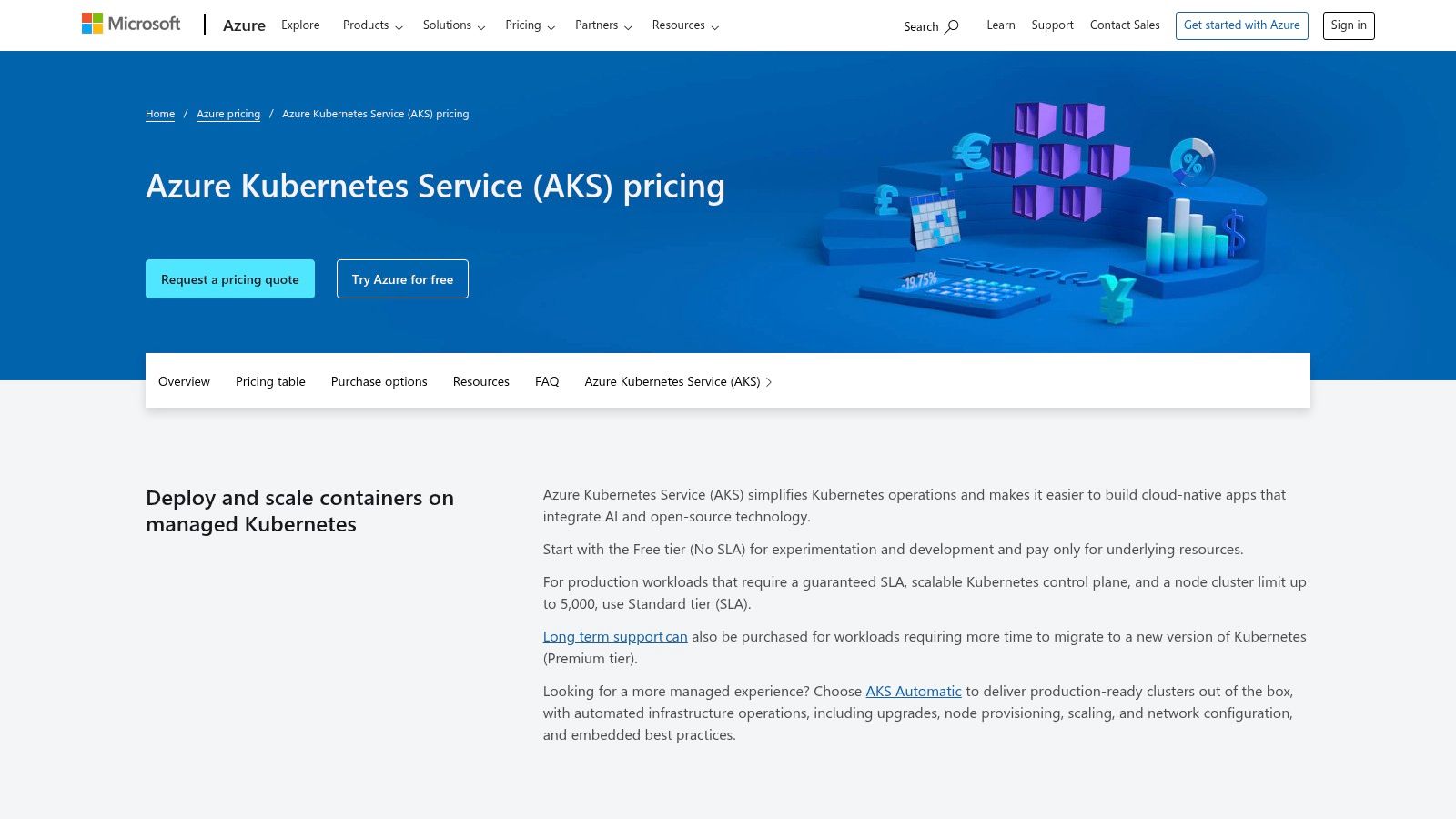
The platform's website clearly outlines its tiered pricing model, which is a key differentiator. Teams can start on a Free tier for development or testing environments, graduate to a Standard tier with a financial uptime SLA for production workloads, or opt for the Premium tier for mission critical applications needing long term support. This flexibility allows cost and features to scale with your project's maturity. Furthermore, the optional AKS Automatic mode can handle node provisioning and cluster upgrades, providing a more hands off operational experience for smaller teams who might lack dedicated platform engineers.
Key Considerations:
- Best For: Companies standardized on Microsoft Azure, seeking deep integration with services like Azure AD and Azure Monitor. Excellent for enterprise environments needing robust security and governance policies.
- Pros: Seamless integration with the broader Azure cloud platform, including networking and identity management. The tiered model provides a clear path to scale from development to production with predictable costs and SLAs.
- Cons: Control plane management fees and feature availability are tied to specific tiers, which can add complexity to cost management. Its strongest features are Azure centric, which may lead to vendor lock in and reduced portability to other cloud environments.
Website: https://azure.microsoft.com/pricing/details/kubernetes-service
5. Red Hat OpenShift
For organizations seeking a production grade, enterprise ready Kubernetes experience out of the box, Red Hat OpenShift is a dominant force. It takes the powerful, open source Kubernetes engine and wraps it in a comprehensive, opinionated platform designed for security, developer productivity, and operational consistency. Think of it as Kubernetes with a full suite of integrated tools, guardrails, and enterprise support, making it one of the best container orchestration tools for businesses that need to move fast without compromising on stability or compliance.
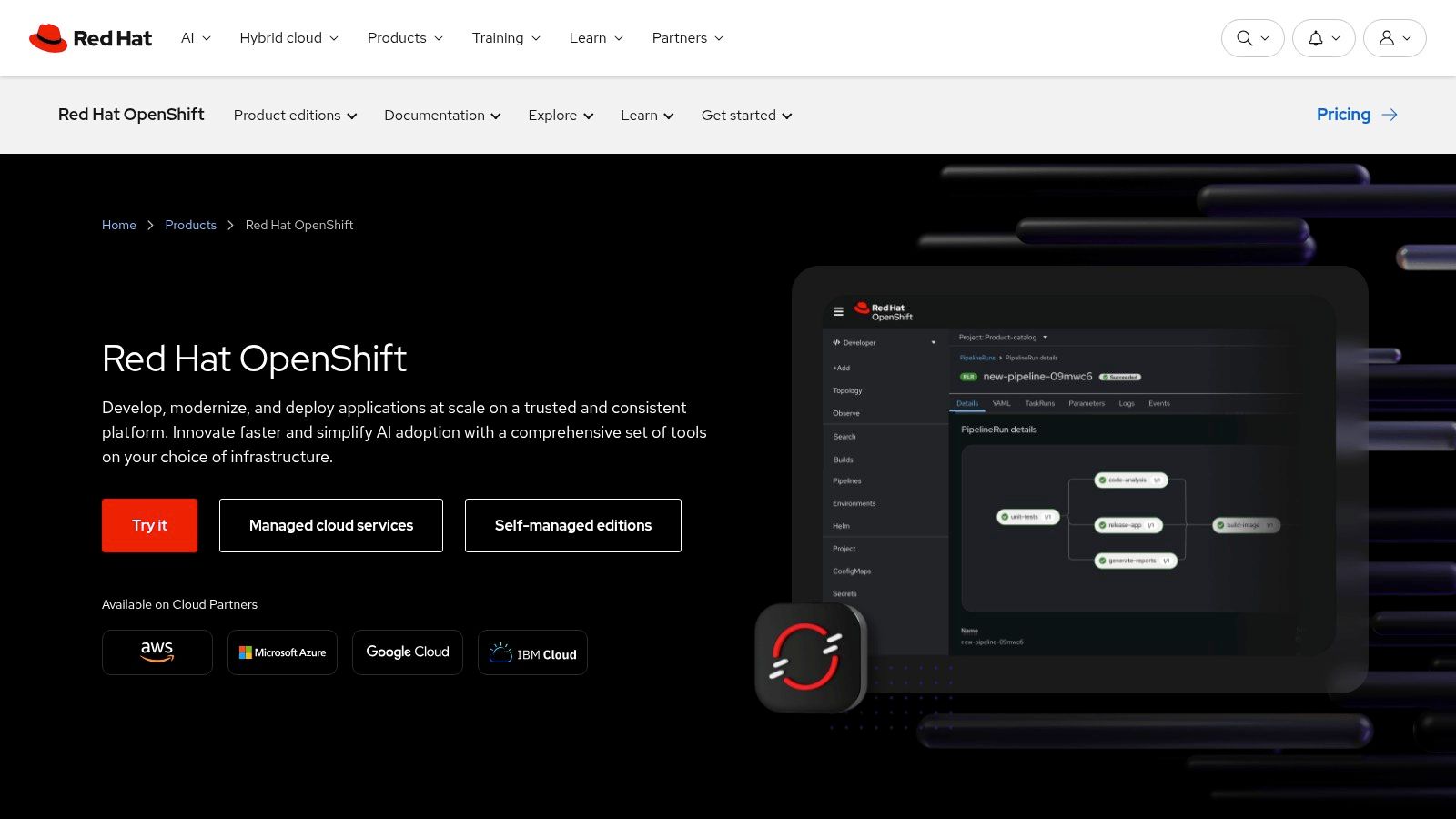
The platform's core value lies in its integrated components, including a built in registry, CI/CD pipelines (OpenShift Pipelines), and the Operator framework for automating application management. This removes much of the complexity of assembling a toolchain from scratch. OpenShift is available as a self managed platform for on premises or cloud deployments, or as fully managed services like ROSA (on AWS) and ARO (on Azure), which come with a 99.95% uptime SLA. Its stringent security posture also means that managing sensitive data is a core consideration, a topic further explored in our guide on the best secrets management tools. This all in one approach is ideal for teams that prioritize a consistent developer experience across hybrid cloud environments.
Key Considerations:
- Best For: Enterprises and regulated industries needing a fully supported, secure, and integrated Kubernetes platform with a consistent experience across hybrid and multi cloud environments.
- Pros: Excellent enterprise support, security certifications, and a robust partner ecosystem. The integrated toolchain accelerates development and simplifies operations.
- Cons: Can be more expensive than vanilla Kubernetes due to platform subscription fees. The opinionated nature may be less flexible for teams with highly customized tooling.
Website: https://www.redhat.com/en/technologies/cloud-computing/openshift
6. SUSE Rancher (Rancher Prime)
For organizations juggling Kubernetes clusters across multiple clouds, on premises data centers, and even edge locations, SUSE Rancher provides a unified control plane to tame the chaos. Instead of being an orchestrator itself, Rancher is a management platform that sits on top of any certified Kubernetes distribution, including EKS, AKS, GKE, or your own self hosted clusters. It centralizes authentication, policy enforcement, and application lifecycle management, making it one of the best container orchestration tools for managing complex, heterogeneous environments from a single pane of glass.
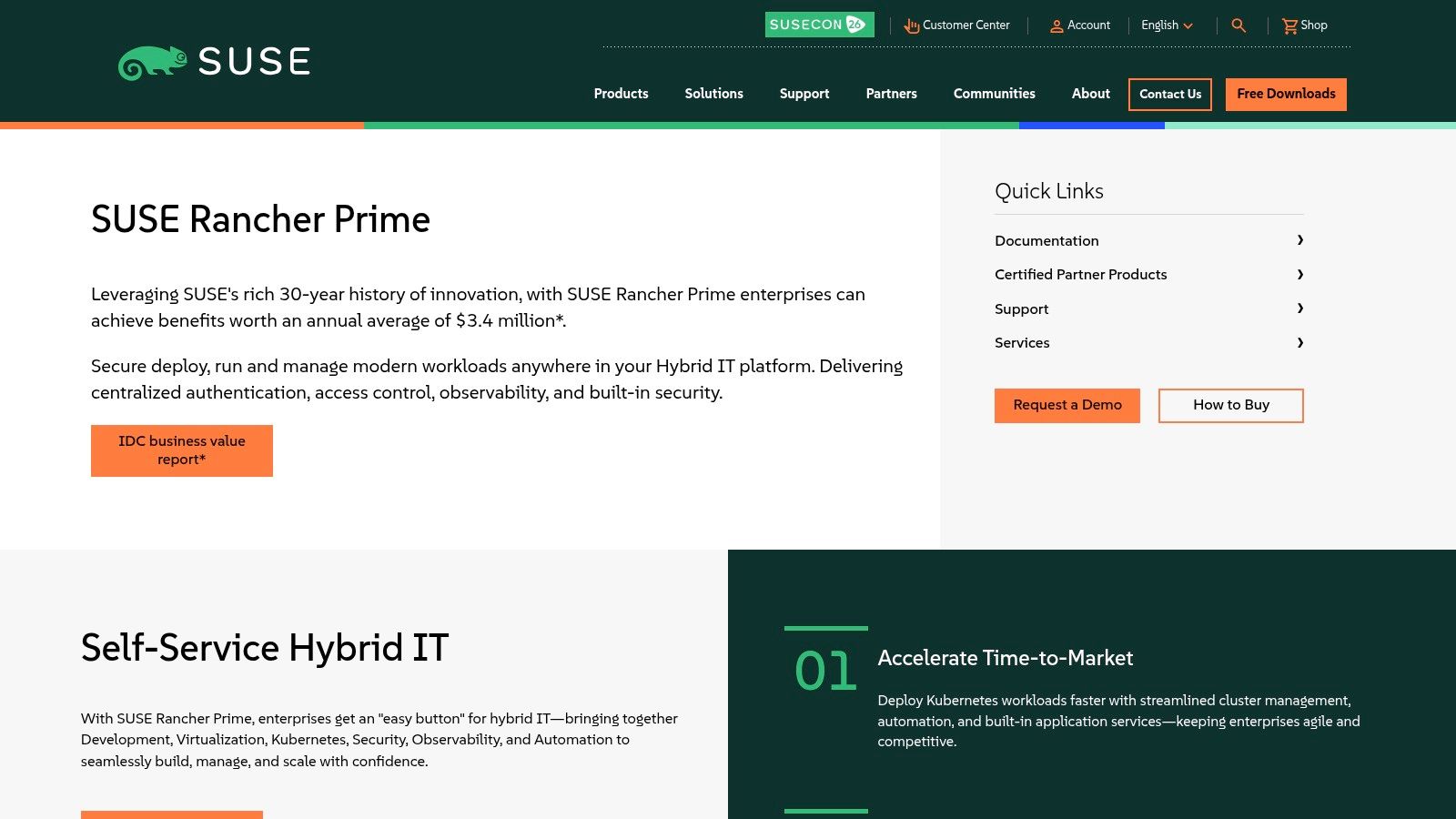
The platform shines in a multi cluster world. Imagine having one team running workloads on GKE for its AI/ML capabilities while another uses AKS for its enterprise integrations. Rancher allows a central operations team to apply consistent security policies, manage user access with unified RBAC, and deploy applications from a shared catalog to both clusters seamlessly. This dramatically reduces the operational burden of managing disparate environments and helps prevent vendor lock in, as you can abstract the management layer from the underlying Kubernetes provider. Its strength is its breadth, but for a startup with just a single cluster, the feature set might be overkill.
Key Considerations:
- Best For: Scale ups and enterprises with multi cloud, hybrid, or edge strategies that need to manage a diverse fleet of Kubernetes clusters from one central point.
- Pros: Excellent for multi cluster and multi cloud fleet management. Abstracts away provider specifics, helping to avoid vendor lock in. Provides unified security, policy, and app catalogs.
- Cons: The full enterprise version, Rancher Prime, is quote based, requiring engagement with a sales team. The feature set can be overly complex for simple, single cluster use cases.
Website: https://www.suse.com/products/rancher
7. Mirantis Kubernetes Engine (MKE) and Mirantis k0s
For organizations that require hardened, enterprise grade Kubernetes deployments outside the typical public cloud ecosystem, Mirantis offers a compelling suite of tools. Their website details two primary offerings: Mirantis Kubernetes Engine (MKE), a full featured platform with a GUI, and k0s, a minimalist, lightweight Kubernetes distribution. Think of MKE as the all inclusive, security first option for complex environments like bare metal or air gapped networks, while k0s is the stripped down, flexible engine for those who need a simple, certified Kubernetes core. This focus on security and deployment flexibility makes it one of the best container orchestration tools for regulated industries.
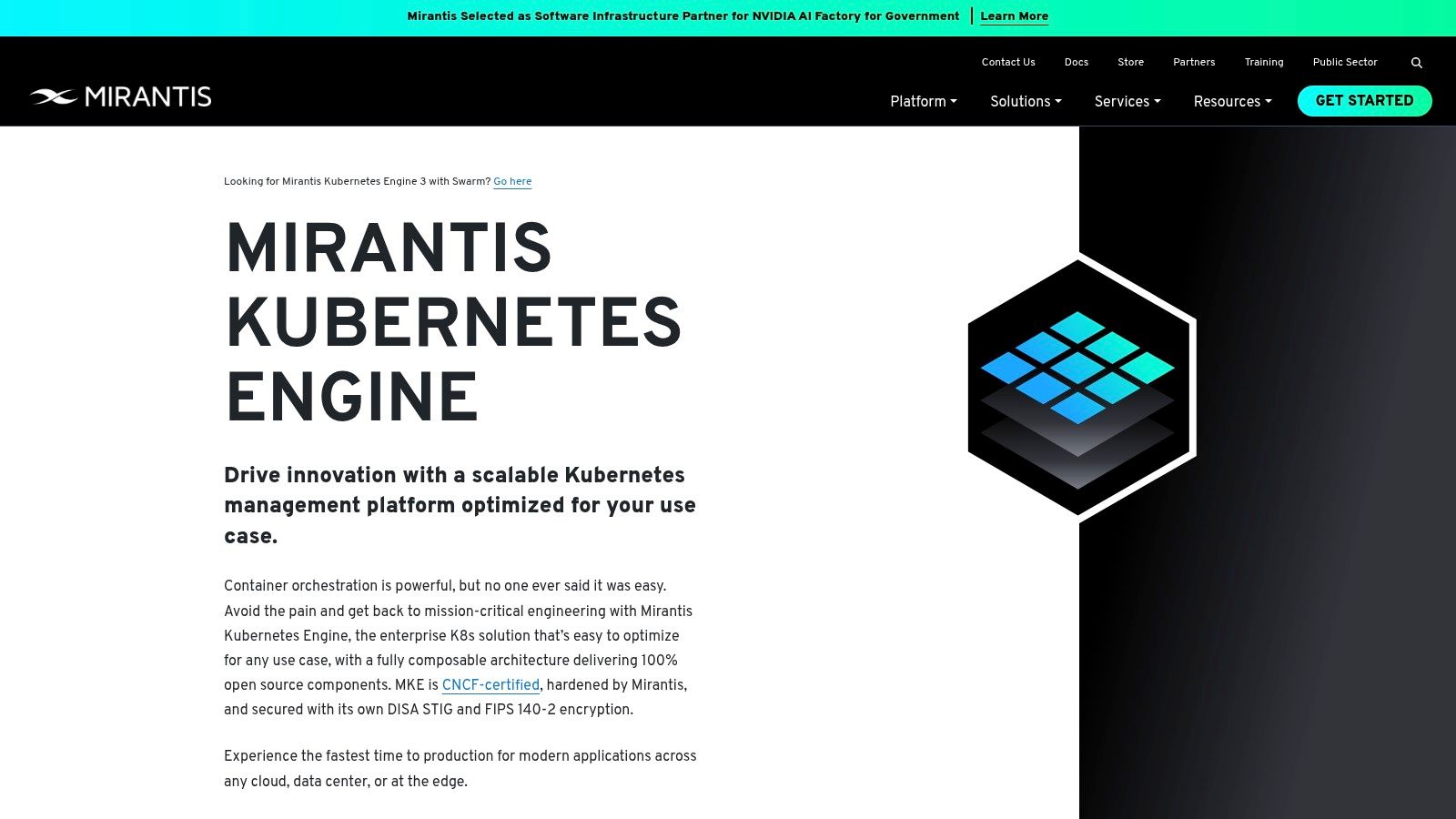
The platform's strength lies in its specialized use cases. MKE notably includes support for both Kubernetes and Docker Swarm orchestrators within the same cluster, providing a migration path for legacy Swarm workloads. This is a unique feature not found in most other distributions. Furthermore, its emphasis on security certifications like FIPS 140 2 and adherence to DISA STIG guidelines makes it a go to for government and financial sector clients. While the core k0s distribution is open source, enterprise support and the full MKE platform are commercial offerings, with pricing typically provided on a quote basis, reflecting its focus on tailored enterprise solutions.
Key Considerations:
- Best For: Enterprises in regulated industries, government agencies, or companies needing to run Kubernetes on premises, on bare metal, or in air gapped environments.
- Pros: Strong security hardening and compliance features. Flexible deployment options that are often challenging for hyperscalers, including robust support for non cloud infrastructure.
- Cons: Pricing is quote based and can be a significant investment. The ecosystem and community are smaller compared to mainstream managed Kubernetes services like EKS or GKE.
Website: https://www.mirantis.com/software/mirantis-kubernetes-engine
8. VMware Tanzu Platform (Broadcom)
For established enterprises already deeply invested in the VMware ecosystem, Tanzu represents a logical, integrated path to modernizing applications with Kubernetes. Now under Broadcom, Tanzu is less of a standalone orchestrator and more of a comprehensive application platform built on Kubernetes, designed to run consistently across private and hybrid clouds. Think of it as adding a Kubernetes native control plane directly into the vSphere foundation that many corporate data centers already rely on. This makes it one of the best container orchestration tools for regulated industries seeking unified governance.
The platform's primary value is its deep integration with VMware Cloud Foundation, offering centralized fleet management and consistent operations for both virtual machines and containers. For platform engineering teams, Tanzu provides robust governance, security, and lifecycle management features essential for operating at scale in air gapped or highly compliant environments. However, this enterprise focus comes with a different acquisition model. Accessing downloads, detailed pricing, and licenses typically requires engaging with a sales team, as it is not a self service, publicly priced product. This model is geared towards large scale, strategic deployments rather than individual developer experimentation.
Key Considerations:
- Best For: Large enterprises and regulated organizations with significant VMware infrastructure looking to adopt Kubernetes with centralized control and security.
- Pros: Seamless integration into existing VMware private clouds, strong enterprise grade governance and lifecycle management, and unified operations for VMs and containers.
- Cons: Not designed for self service; requires a sales led purchasing process with no public pricing. High barrier to entry for startups or small teams.
Website: https://www.vmware.com/tanzu
9. HashiCorp Nomad
For teams who find Kubernetes' operational complexity daunting but still need a powerful, flexible scheduler, HashiCorp Nomad presents a compelling alternative. Nomad is a simpler, lightweight, and more flexible orchestrator designed to be easy to use and maintain. Its architecture, centered around a single binary, allows it to schedule not just containers but also virtual machines and standalone applications, making it one of the best container orchestration tools for managing diverse, heterogeneous workloads across on premises data centers and the cloud.
The primary value of Nomad is its operational simplicity and its seamless integration with the broader HashiCorp ecosystem, including Consul for service discovery and Vault for secrets management. This creates a powerful, cohesive platform for application delivery without the steep learning curve of the Kubernetes ecosystem. It is an excellent choice for startups or scale ups that need robust scheduling capabilities for microservices architecture without dedicating a large team to platform management. To better understand how Nomad fits into a modern stack, explore these microservices architecture best practices for 2025. This approach allows developers to focus more on applications and less on the underlying infrastructure.
Key Considerations:
- Best For: Teams seeking a simpler alternative to Kubernetes, especially for mixed workload environments (containers, VMs, binaries) or edge computing scenarios.
- Pros: Significantly lower operational overhead and a gentler learning curve. A single binary and simple architecture make it easy to deploy and manage. Natively supports non containerized workloads.
- Cons: The ecosystem of third party tools and community support is smaller than Kubernetes. Advanced features like multi cluster federation are often part of the paid enterprise version.
Website: https://www.hashicorp.com/products/nomad
10. DigitalOcean Kubernetes (DOKS)
For startups, small businesses, or developers who find the complexity of hyperscaler Kubernetes offerings daunting, DigitalOcean Kubernetes (DOKS) presents a refreshingly simple alternative. It strips away the intricate billing and overwhelming feature sets of larger providers, focusing instead on a straightforward, predictable, and developer friendly experience. DOKS is designed for teams that need to get a production ready cluster running quickly without a dedicated DevOps army. This focus on simplicity makes it one of the best container orchestration tools for projects where speed and cost transparency are paramount.
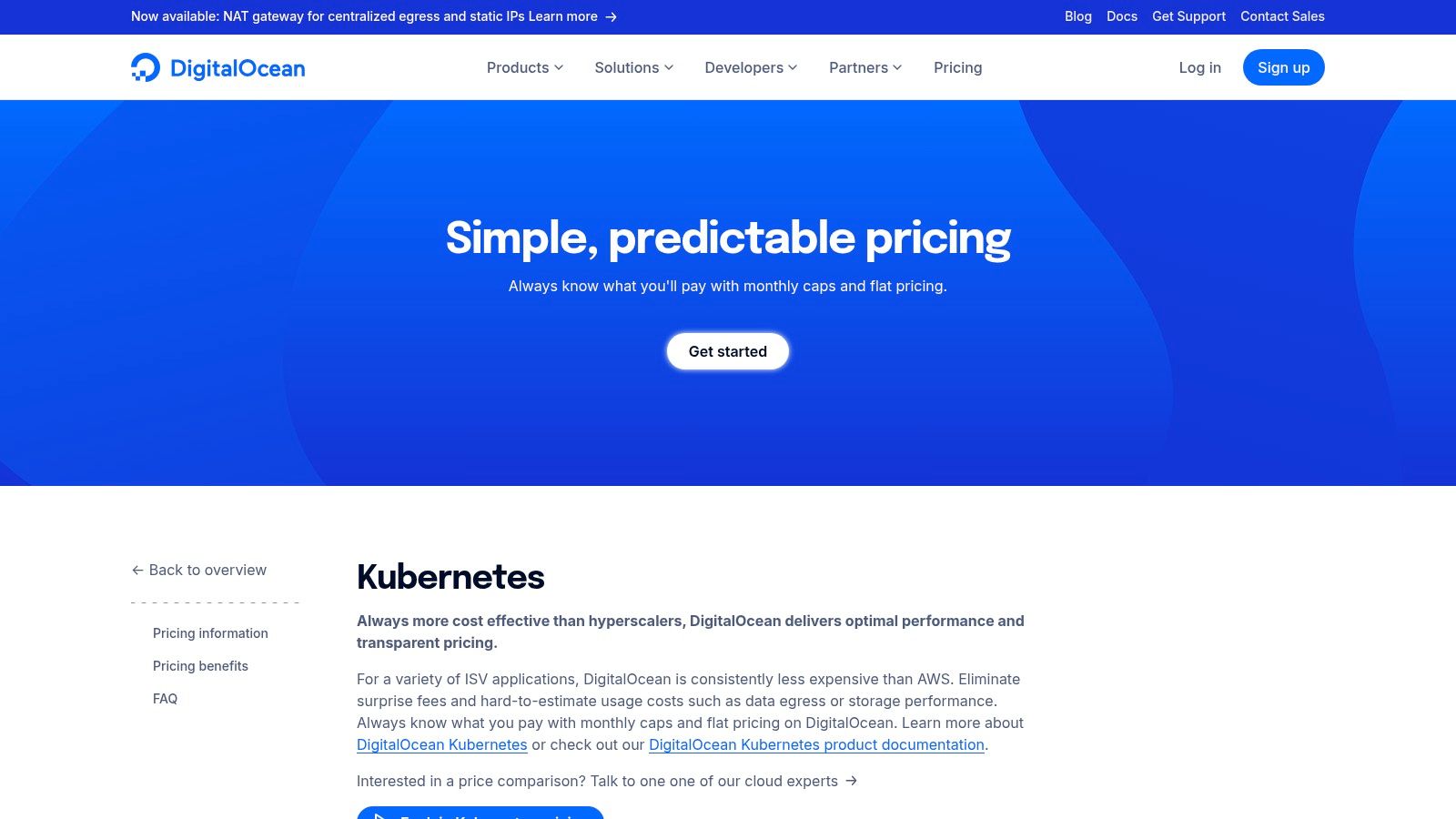
The primary value of DOKS is its pricing model and ease of use. The control plane is free by default, a significant cost saving for smaller workloads, with an optional high availability upgrade for a flat monthly fee. Node pricing is transparent and aligns with their standard Droplet costs, making budget forecasting incredibly easy. The clean user interface and well crafted doctl command line tool allow for rapid cluster provisioning and management. While it might lack the extensive global footprint or the deep enterprise integrations of AWS or Google Cloud, it excels at providing a solid, no nonsense managed Kubernetes service that lets small teams focus on building applications rather than managing infrastructure.
Key Considerations:
- Best For: Startups, SMBs, and individual developers seeking a cost effective, easy to manage Kubernetes platform without the complexity of major cloud providers.
- Pros: Extremely beginner friendly with a simple UI and CLI. Predictable, transparent pricing with a free control plane tier makes it very affordable for small to medium workloads.
- Cons: Limited global region availability compared to hyperscalers. Fewer advanced networking, security, and enterprise grade features.
Website: https://www.digitalocean.com/pricing/kubernetes
11. IBM Cloud Kubernetes Service (IKS)
For organizations already invested in the IBM ecosystem or seeking enterprise grade security and support, the IBM Cloud Kubernetes Service (IKS) offers a managed path to container orchestration. It provides a native Kubernetes experience where IBM manages the control plane, allowing your team to focus on deploying applications rather than cluster administration. This makes it one of the best container orchestration tools for businesses that value integration with IBM's extensive catalog of cloud services, from databases to AI and messaging.
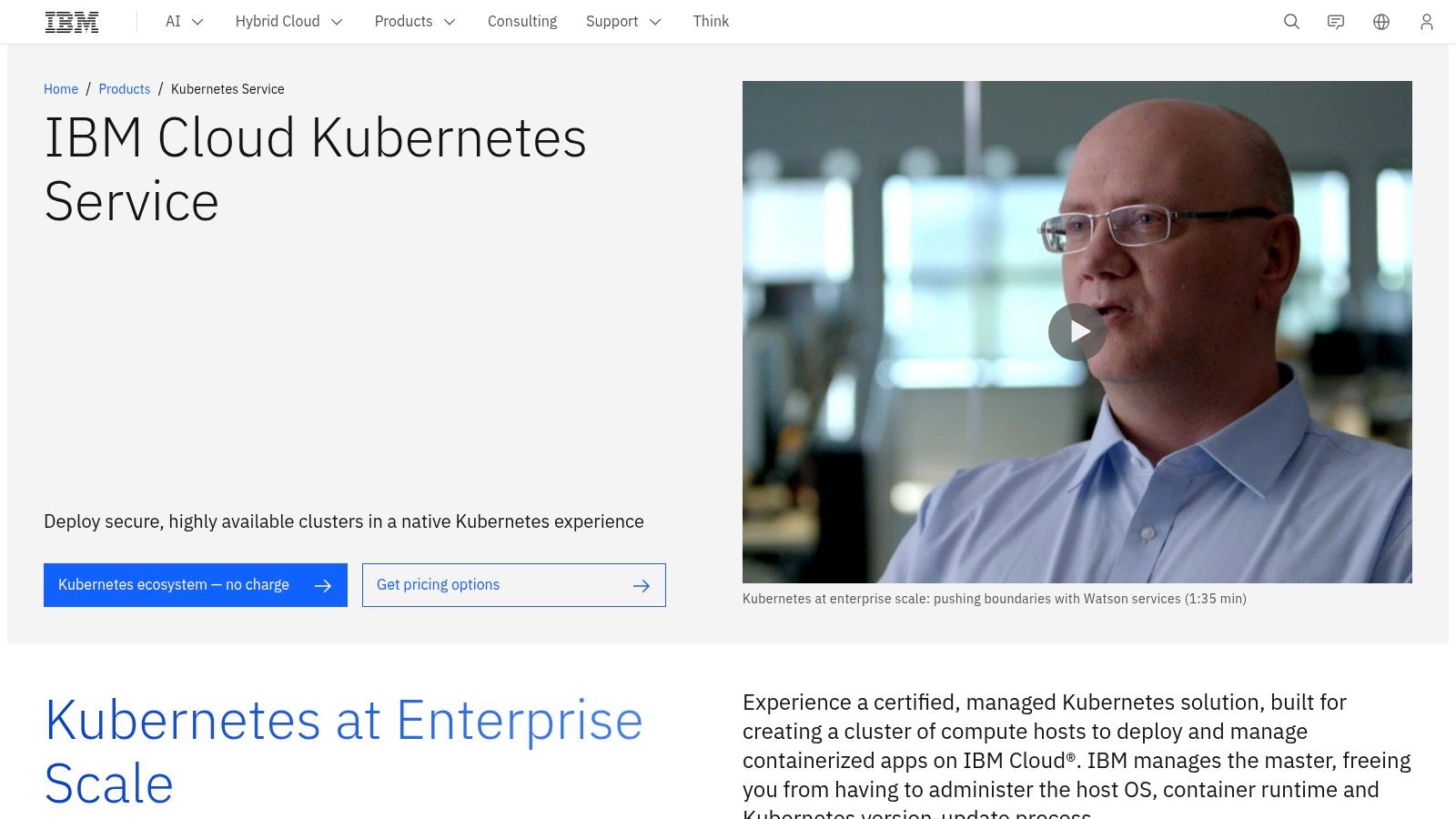
A key differentiator for IKS is its role as a strategic onramp to Red Hat OpenShift on IBM Cloud. This provides a clear and straightforward migration path for enterprises that might start with standard Kubernetes but anticipate needing the additional developer productivity tools, CI/CD pipelines, and multi tenancy features that OpenShift provides. This foresight makes IKS a pragmatic choice for teams planning for long term growth and complexity. While its feature set is tightly integrated with the IBM Cloud ecosystem, this focus ensures seamless operation for those leveraging IBM's platform and robust support programs.
Key Considerations:
- Best For: Enterprises committed to the IBM Cloud ecosystem or those planning a future migration to Red Hat OpenShift.
- Pros: Strong enterprise support options and a clear, simple upgrade path to the more comprehensive OpenShift platform. Deep integration with IBM's service catalog.
- Cons: The platform's integrations and tooling are heavily centered on the IBM Cloud, which can feel limiting compared to hyperscalers. It also has a smaller global region footprint than AWS, Azure, or GCP.
Website: https://www.ibm.com/products/kubernetes-service
12. Oracle Container Engine for Kubernetes (OKE)
For organizations deeply integrated into the Oracle ecosystem or those prioritizing cost optimization on cloud infrastructure, Oracle Container Engine for Kubernetes (OKE) presents a compelling, managed Kubernetes service. It is Oracle's answer to EKS, GKE, and AKS, running on Oracle Cloud Infrastructure (OCI). What makes it one of the best container orchestration tools in specific scenarios is its pricing model and tight integration with high performance Oracle databases, making it ideal for data intensive applications that need low latency access to services like Exadata or Autonomous Database.
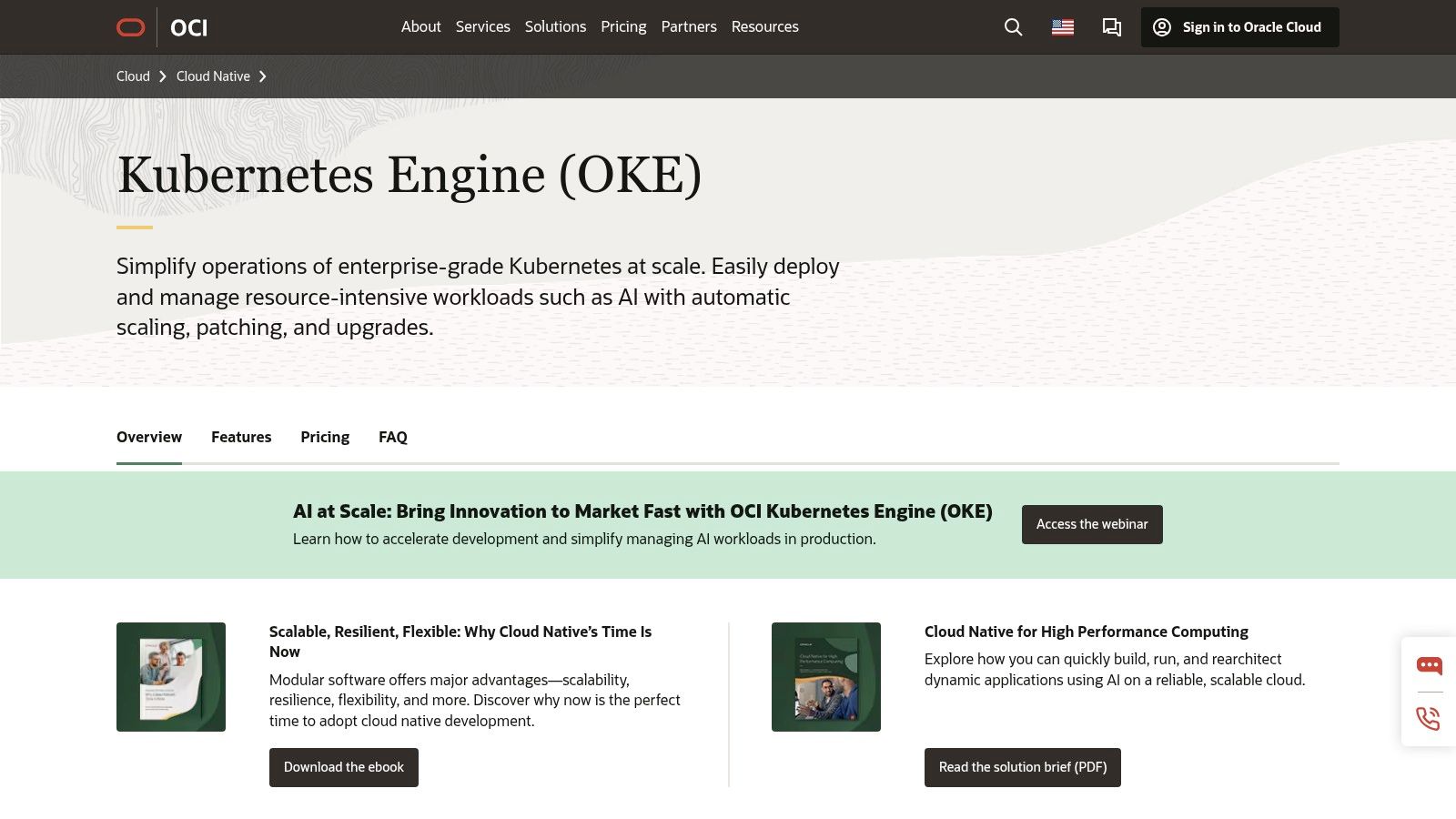
OKE's unique value proposition is its "Basic cluster" offering, which provides the Kubernetes control plane at no cost; you only pay for the worker nodes and associated resources like networking and storage. While a paid tier with a control plane SLA exists for production critical workloads, the no fee option is an attractive entry point. This makes OKE particularly appealing for companies running significant workloads on OCI, as it can lead to a lower total cost of ownership compared to other major cloud providers, especially when leveraging OCI's competitive compute and networking prices.
Key Considerations:
- Best For: Enterprises already invested in Oracle Cloud Infrastructure or those with workloads requiring high performance, low latency connections to Oracle databases.
- Pros: Potential for significant cost savings due to OCI's pricing and the no fee control plane option. Excellent integration with the broader OCI ecosystem.
- Cons: The surrounding ecosystem of tools and community support is smaller than that of AWS, Google Cloud, or Azure. Some advanced features, like virtual nodes, are tied to the paid control plane tier.
Website: https://www.oracle.com/cloud/cloud-native/kubernetes-engine
Top 12 Container Orchestration Tools: Side by Side Comparison
| Platform | Primary value / best for | Core features / differentiator | Target audience | Pricing & notes |
|---|---|---|---|---|
| Kubernetes (upstream, open source) | Vendor neutral, self managed K8s | CNCF upstream, widest ecosystem, cross cloud/on prem | Teams wanting full control, learning, portability | Free OSS; high ops overhead for control plane & security |
| Amazon EKS | Managed K8s with deep AWS integration | Managed control plane, IAM, ALB, CloudWatch, Fargate | AWS centric enterprises & production workloads | Paid (control plane/nodes); AWS centric features may increase cost |
| Google Kubernetes Engine (GKE) | Optimized managed K8s with Autopilot | Standard/Autopilot modes, fleet multi cluster, strong autoscaling | Teams wanting hands off ops and cost visibility | Paid; Autopilot pod billing; free credits for small usage |
| Azure Kubernetes Service (AKS) | Azure integrated K8s with tiering | Free/Standard/Premium tiers, Azure AD, AKS Automatic | Azure invested teams needing identity & policy integration | Control plane charges vary by tier; pick cost vs SLA |
| Red Hat OpenShift | Opinionated enterprise platform & developer UX | Operators, CI/CD, integrated registry; managed variants (ROSA/ARO) | Large enterprises needing certified platform & support | Higher platform fees; managed offerings add per cluster costs |
| SUSE Rancher (Rancher Prime) | Centralized multi cluster & multi distro management | Unified lifecycle, RBAC, policy enforcement, app catalogs | Organizations with heterogeneous clusters / multi cloud fleets | Quote based pricing; may be overkill for single clusters |
| Mirantis (MKE & k0s) | Hardened enterprise K8s + lightweight distro | MKE GUI/RBAC/registry; k0s minimal distro; air gap/bare metal support | Sec sensitive orgs, bare metal or air gapped environments | Quote based support/licensing; smaller ecosystem |
| VMware Tanzu Platform | Private cloud & regulated environment Kubernetes | Central governance, fleet mgmt, VMware Cloud integrations | VMware centric private clouds and regulated enterprises | Sales led licensing; entitlements often required |
| HashiCorp Nomad | Simple scheduler for mixed workloads | Single binary, schedules containers/VMs/binaries; Consul/Vault integration | Teams valuing simplicity or mixed workload scheduling | OSS + paid enterprise; smaller add on ecosystem |
| DigitalOcean Kubernetes (DOKS) | Beginner friendly K8s for SMBs & startups | Free control plane, flat node pricing, simple UI/CLI | Startups, developers, small to mid workloads | Predictable node costs; fewer advanced enterprise features |
| IBM Cloud Kubernetes Service (IKS) | K8s with IBM service integrations & OpenShift path | IBM managed control plane, service catalog, OpenShift migration path | Enterprises using IBM Cloud & seeking vendor support | Enterprise support offerings; smaller region footprint |
| Oracle Container Engine (OKE) | OCI integrated K8s with low cost control plane option | Basic no fee control plane, paid SLA tier, OCI compute/network pricing | Oracle/OCI customers and DB adjacent workloads | Basic free control plane; paid SLA for advanced features |
Choosing Your Conductor: The Final Note
We have navigated the vast and dynamic ocean of container orchestration, from the immense power of upstream Kubernetes to the streamlined simplicity of managed services like DigitalOcean Kubernetes and the unique philosophical approach of HashiCorp Nomad. The journey through this landscape of the best container orchestration tools can feel overwhelming. It's a world filled with powerful options, each with its own community, ecosystem, and steep learning curves. If you take away one single truth from this exploration, let it be this: there is no universal "best" tool. The best choice is the one that best fits your specific context.
The right orchestrator for your team is a deeply personal decision, influenced by a unique cocktail of technical requirements, team expertise, business goals, and budget constraints. It's less about picking the most feature rich platform and more about selecting the most effective enabler for your specific mission. Think of it as choosing a vehicle. You would not use a Formula 1 car for a cross country road trip, nor would you use a minivan for a racetrack. The context dictates the choice.
Recapping the Decision Matrix
Let's distill our findings into a final checklist to guide your thinking. Before you commit to a platform, reflect honestly on these core pillars:
- Operational Burden vs. Control: This is the foundational tradeoff. Do you have a dedicated platform engineering team ready to tame the complexities of upstream Kubernetes, or would your developers be better served by the "just works" experience of a managed service like GKE Autopilot or AWS EKS with Fargate? For an early stage startup, every hour spent on infrastructure is an hour not spent on product.
- Ecosystem & Vendor Lock In: How important is portability? Committing to a cloud provider's managed Kubernetes (EKS, GKE, AKS) offers incredible integration benefits, streamlining everything from IAM to observability. However, it also ties you more closely to that ecosystem. Tools like Nomad, Rancher, or vanilla Kubernetes offer a more agnostic path, but require you to build those integration bridges yourself.
- Workload Specific Needs: Your application architecture is a critical factor. Are you running stateless Django web applications, or complex, stateful GenAI and VoiceAI pipelines? Workloads requiring specialized hardware like GPUs for model training might push you towards GKE or EKS, which have mature, well documented support for these use cases. For simpler, more predictable workloads, a tool like Docker Swarm or Nomad could be a perfectly pragmatic and cost effective choice.
- Cost & Scalability Trajectory: Do not just plan for today; plan for where you will be in 18 months. A simple, low cost solution might be perfect for your current MVP. But will it support the scaling demands when your user base grows tenfold? Analyze the pricing models carefully. Pay as you go managed services can seem cheap initially but can lead to surprising bills at scale, whereas a self managed cluster might have a higher upfront operational cost but be more predictable long term.
Your Actionable Next Steps
The journey from reading this article to a production ready deployment is a practical one. Theory will only take you so far.
- Shortlist Two or Three Candidates: Based on the profiles and your self assessment, pick your top contenders. Maybe it is GKE for its AI/ML prowess and Nomad for its simplicity.
- Define a Proof of Concept (PoC): Choose a small, non critical service. Your goal is not to boil the ocean but to get a feel for the developer experience. Can you deploy your application? Can you configure logging and monitoring? How intuitive is the CLI or UI?
- Talk to Your Team: The best tool is one your team will actually use and enjoy. Involve your engineers in the PoC process. Their feedback on the day to day workflow is invaluable and will be the ultimate driver of adoption and success.
Ultimately, choosing from the best container orchestration tools is about finding a strategic partner for your application's lifecycle. It's the silent conductor that ensures every container, every service, and every workload performs its part in harmony, allowing you to focus on composing the music: your product.
Navigating these choices, especially for early stage AI startups, can be a high stakes decision that sets the foundation for future growth. If you are looking for a technical partner to help you design, audit, or implement a production grade architecture using these tools, Kuldeep Pisda offers specialized consulting and CTO as a service engagements. Visit Kuldeep Pisda to see how we can help you build a scalable and resilient foundation for your vision.
Subscribe to our newsletter.
Become a subscriber receive the latest updates in your inbox.
Member discussion