

I've been in that Monday morning meeting. You know the one. Coffee in hand, staring down a two hour calendar invite for "Sprint Planning." You brace yourself for a rambling discussion, scope creep happening in real time, and a team that leaves feeling more confused than committed. It's the kind of meeting that truly could have been an email, or at least a much more focused conversation.
I once led a team where our planning sessions became so bloated we called them 'sprint meandering'. We would consistently overcommit, wildly underestimate complexity, and then spend the next two weeks firefighting our way to the finish line. It felt like we were always one step behind. It was exhausting, demoralizing, and completely unsustainable. That painful experience forced me to get serious about finding a better way, moving from chaotic guesswork to a structured, predictable process.
So this isn't just another theoretical list. This is a roundup of the battle tested, practical sprint planning best practices that helped us climb out of that hole. If you're an engineering leader at a fast moving startup and want to turn your planning from a dreaded chore into a genuine strategic advantage, you're in the right place. We're going to explore ten actionable techniques to help you avoid the same pitfalls. Let's level up your process, one practice at a time.
1. Define a Clear Sprint Goal (Your North Star)
Before a single user story is even mentioned, let's pause. A successful sprint planning session starts with a clear, unified answer to one question: "What are we really trying to achieve in this sprint?" A Sprint Goal is not just a collection of backlog items; it is a concise, high level summary of the value the team aims to deliver. This goal provides the team with a north star, a unifying purpose that guides decision making and promotes focus throughout the sprint. It transforms a scattered list of tasks into a cohesive mission.
This practice, popularized by Scrum co creators Jeff Sutherland and Ken Schwaber, is one of the most foundational sprint planning best practices because it provides context and purpose. Without a clear goal, the team is just completing tickets. With one, they are collaborating to achieve a meaningful outcome. For example, a goal like "Complete tickets UI 123, API 456, and DB 789" is uninspiring and misses the point. A much better goal is "Launch the V1 of our user profile page to allow customers to update their personal information." See the difference? One is a to do list, the other is a mission.
Why This Is My Go To Practice
Defining a clear goal aligns the entire team, from engineers to the product owner, on a shared objective. This alignment is critical in a fast paced startup environment where priorities can shift daily. It empowers the team to make autonomous decisions during the sprint. If an unexpected issue arises, they can ask, "Does this new task help us reach our Sprint Goal?" This focus prevents scope creep and ensures the most valuable work gets done. I have seen this single change reduce mid sprint interruptions by more than half.
Actionable Tips for Implementation
- Make It a Team Sport: The Product Owner may come prepared with a draft, but the final goal should be a collaborative effort. Shared ownership fosters greater commitment.
- Keep it Visible: Don't let the goal get lost in a document. Display it prominently on your physical or digital task board so it's a constant reminder of the mission.
- Limit to One or Two Goals: Trying to achieve too much dilutes focus. A single, powerful goal is often more effective than three mediocre ones.
- Connect to the Bigger Picture: Ensure each Sprint Goal is a measurable step toward a larger product milestone or quarterly objective. Atlassian, for instance, mandates that sprint goals are documented and linked to larger epics in Jira before planning even begins.
2. Tame the Product Backlog Before the Meeting
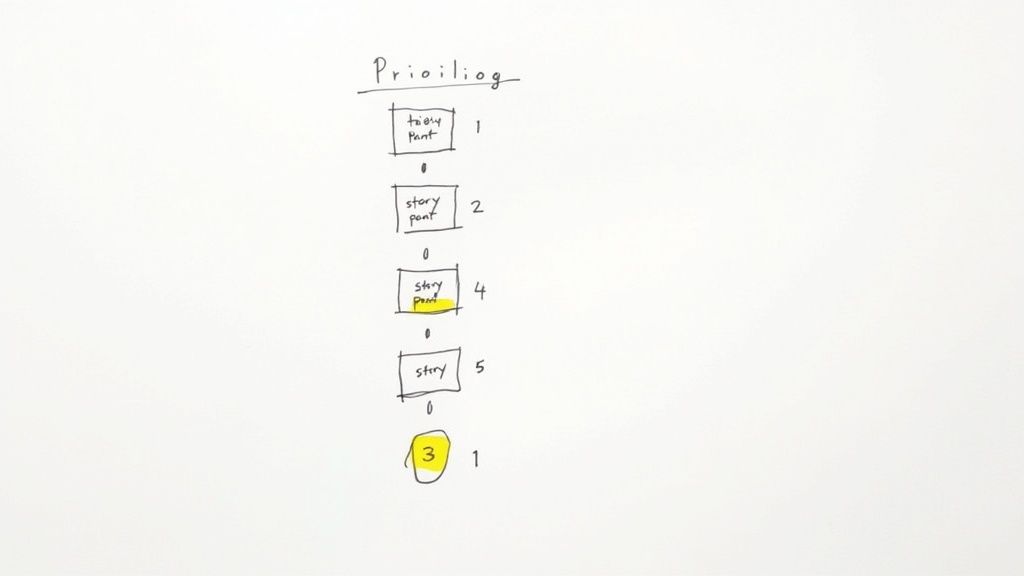
Effective sprint planning is impossible with a messy, oversized, and poorly ordered product backlog. Think of your backlog as the team's pantry; if it's disorganized, you can't cook a coherent meal. The goal is to maintain a continuously refined, prioritized, and "right sized" backlog where items are small enough to complete within a sprint. This means the work at the top is crystal clear, while items further down can remain a bit fuzzy.
This practice, championed by agile thought leaders like Mike Cohn, ensures the team isn't blindsided by vague or massive tasks during the planning meeting. We have all been there, trying to estimate a story that is just one sentence long. It's a recipe for disaster. Instead of that chaotic free for all, the team pulls from a well prepared list of high value, sprint ready work. A single backlog item like "Build user authentication" is far too large. To effectively break down work for sprint planning, it's helpful to understand larger organizational units. For instance, an Agile Epic Example like this should be decomposed into smaller user stories such as "As a user, I want to sign up with an email and password" and "As a user, I want to log in with my credentials."
Why This Is a Game Changer
A well groomed backlog dramatically reduces the time and friction of sprint planning itself. When the team arrives, the highest priority work is already understood, estimated, and ready to be pulled into the sprint. This transforms the meeting from a painful discovery session into a confirmation and commitment ceremony. It eliminates ambiguity, identifies dependencies early, and ensures engineering efforts are always focused on the most critical business objectives. Companies like Shopify use weighted scoring models (like RICE or ICE) to ensure their backlog prioritization is data driven and aligned with strategic goals, making planning sessions highly efficient.
Actionable Tips for Implementation
- Make Refinement a Habit: Dedicate time for backlog refinement (or "grooming") in the sprint preceding the planning session. This should be a recurring meeting, not an afterthought. Seriously, put it on the calendar.
- Follow the 20% Rule: Aim to have the top 20% of your backlog, or at least two sprints' worth of work, fully refined and "ready" at all times.
- Use Story Mapping: This technique, popularized by Jeff Patton, helps visualize the user journey and break down large features into a logical flow of smaller, valuable stories. It's a fantastic way to see the forest for the trees.
- Define "Ready": Establish a clear "Definition of Ready" for backlog items. This checklist might include having clear acceptance criteria, a user story format, and an initial estimate. No ticket gets in without meeting these criteria.
3. Use a Timebox (and Stick to It)
One of the quickest ways for a sprint planning meeting to derail is by letting it run indefinitely. A timeboxed session solves this by enforcing a strict time limit, a practice that forces focus, prioritization, and decisive action. Instead of getting lost in endless debates over minor details, the team is compelled to make efficient choices to fit within the allotted time. It felt weird at first, but this structure transformed our sprawling discussions into highly productive, focused events.
This concept, a core tenet of the Scrum framework, is one of the most critical sprint planning best practices for maintaining momentum. The official Scrum Guide suggests a maximum of eight hours for a one month sprint, scaling down proportionally for shorter sprints (e.g., four hours for a two week sprint). The time constraint creates a sense of urgency, ensuring that the most important topics are addressed first and that discussions remain centered on the sprint goal.

Why This Simple Trick Works So Well
Timeboxing respects everyone's time and prevents meeting fatigue, a common ailment in fast moving startups. It establishes a rhythm and predictability for the team's ceremonies. When the team knows a meeting has a hard stop, they are more inclined to stay on topic and drive toward a conclusion. This forces the team to prioritize discussions; if a particular user story is consuming too much time, the team can quickly decide to move it back to the backlog for further refinement rather than derailing the entire plan. Google's engineering teams are known to use visible countdown timers during planning to keep everyone aware of the remaining time and maintain a crisp pace.
Actionable Tips for Implementation
- Set and Share an Agenda: Prepare a clear agenda beforehand and distribute it at least 24 hours in advance. This allows the team to come prepared.
- Use a Visible Timer: Display a countdown timer on a shared screen. This visual cue is a powerful, non confrontational way to keep the meeting on track. Trust me, it works.
- Establish a "Parking Lot": Create a space on a physical or digital board for topics that are important but not critical to the immediate planning session. This prevents scope creep while ensuring ideas are not lost.
- Split the Session if Needed: For longer sprints, consider breaking the planning meeting into two parts: a high level session for goal setting and a second, more detailed session for task breakdown and estimation.
4. Involve the Entire Team, Not Just the Leads
Sprint planning is not a spectator sport where the Product Owner and a lead engineer dictate terms. A truly effective planning session is a collaborative, whole team activity. This means developers, QA testers, designers, and any other relevant contributors are active participants, not just passive listeners. By bringing diverse perspectives to the table, the team can uncover hidden complexities, improve estimates, and collectively commit to the sprint goal. This practice transforms planning from a top down directive into a shared strategic exercise.
The core principle here is that those who do the work are best equipped to plan it. When engineers are involved in breaking down user stories, they can identify technical dependencies and potential roadblocks a product manager might miss. I once saw a designer point out a UI complexity that saved us days of rework because it was caught before a single line of code was written. This level of involvement is a cornerstone of sprint planning best practices.
Why It's Better Together
Involving the entire team generates a more accurate and realistic sprint backlog. Diverse viewpoints lead to better problem solving and risk identification before the sprint even starts. This collective ownership drastically increases commitment; when the team builds the plan together, they are more invested in seeing it succeed. Zappos famously empowers its development teams by ensuring they are active decision makers in all planning, which fosters a powerful sense of autonomy and responsibility.
Actionable Tips for Implementation
- Create Psychological Safety: Explicitly encourage questions and challenges. Make it clear that all input is valuable, and there are no bad questions.
- Use Round Robin Techniques: To prevent the loudest voices from dominating, go around the room and ask each person for their thoughts on a story or the overall plan.
- Facilitate, Don't Dictate: The Scrum Master or engineering lead's role is to guide the conversation, not provide all the answers. Ask open ended questions to stimulate discussion.
- Explicitly Ask for Concerns: Before finalizing the sprint backlog, ask directly: "What are your biggest concerns about this plan?" or "What potential risks are we overlooking?" This gives a formal opportunity for dissent.
5. Be Brutally Honest About Your Capacity
One of the most common reasons sprints fail is overcommitment. Teams, driven by ambition and a desire to please stakeholders, often bite off more than they can chew. Realistic capacity planning is the antidote. It's the practice of calculating how much productive time your team actually has for new sprint work, after accounting for all the meetings, holidays, PTO, and bug fixes that are a part of life. It moves the team from wishful thinking to data driven planning.
This approach grounds sprint planning in reality. Instead of just looking at a velocity number, you look at the available hours. The calculation is simple: total available workdays minus meetings, holidays, paid time off, and a buffer for unplanned work. This ensures the sprint backlog is achievable, which boosts morale and creates a sustainable pace. It's a core component of effective sprint planning best practices because it prevents burnout and builds trust.
Why This Is the Foundation of Predictability
Accurate capacity planning is the foundation of a trustworthy development process. When a team consistently delivers on its sprint commitments, it builds credibility with stakeholders. This practice directly combats the demoralizing cycle of sprint failures. For instance, teams at Facebook often reserve around 20% of their capacity for emergent work and paying down tech debt, acknowledging that not all valuable work can be planned. This honesty about capacity is what separates high performing teams from the rest.
Actionable Tips for Implementation
- Establish a Baseline: Track your team's actual time spent on planned work versus other activities for two or three sprints. This historical data is your most accurate guide.
- Assume Unavailability: A good starting point is to assume that only 70 to 75% of a person's time is available for new sprint tasks. The rest is consumed by meetings, emails, and context switching.
- Account for Absences Explicitly: Before planning, ask about any known days off, holidays, or appointments. A single person's absence can significantly impact the team's total capacity.
- Be Conservative Initially: If your team is new to capacity planning, it is better to undercommit and pull in more work later than to overcommit and fail. Your estimates will improve over time. You can learn more about building a guide to a realistic software project estimate to refine this process.
6. Use Story Points, Not Hours
Humans are notoriously bad at estimating work in absolute units like hours or days. We just are. A much more reliable approach is to estimate work relatively, comparing the effort, complexity, and uncertainty of one task against another. Story points are an abstract measure used by agile teams to capture this relative effort. This technique shifts the conversation from "How long will this take?" to "How big is this compared to that?" and it is a cornerstone of effective sprint planning best practices.
This practice avoids the false precision of time based estimates. A task estimated at eight hours might take a senior engineer four hours and a junior engineer twelve, making the estimate dependent on who does the work. A task estimated at 5 story points, however, represents a consistent level of effort for the team as a whole. It's about the size of the problem, not the time it takes any one person to solve it. This was a huge unlock for my teams; it stopped the endless debates about hours and focused us on the work itself.
Why This Is So Much Better Than Hours
Relative estimation decouples effort from time, leading to more accurate long term forecasting. By tracking the number of story points completed per sprint (the team's "velocity"), you can predict how much work the team can likely handle in future sprints. This fosters important technical discussions. When engineers debate whether a story is a 3 or an 8, they are uncovering hidden complexities and assumptions, which is far more valuable than arguing over whether it will take 16 or 24 hours. This data driven approach also provides a clearer picture of your team's delivery capacity. To dive deeper into this subject, you can explore this guide to engineering productivity measurement.
Actionable Tips for Implementation
- Establish Reference Stories: Choose a few well understood, completed user stories to serve as benchmarks. For example, "A simple text change on the homepage is a 1" or "Implementing a new API endpoint with basic validation is a 3."
- Use Planning Poker: This collaborative technique ensures everyone's voice is heard. Each team member privately selects a story point card, and everyone reveals their estimate simultaneously. This prevents anchoring bias from the most senior person in the room.
- Discuss Outliers: If estimates vary widely (e.g., one person says 2 and another says 8), it's a signal to discuss. The person with the high estimate might see risks others missed, while the person with the low estimate may know a simpler solution. This is where the magic happens.
- Track and Use Velocity: Calculate the team's average velocity over the last 3 to 5 sprints to guide how much work you pull into the next one. Don't treat it as a rigid target, but as a helpful guideline.
7. Hunt for Risks and Dependencies
A sprint plan built on unchecked assumptions is a house of cards waiting to collapse. One of the most mature sprint planning best practices is to proactively confront the question, "What could go wrong?" By explicitly identifying potential risks, blockers, and dependencies before the sprint begins, the team can move from a reactive, firefighting mode to a proactive, strategic one. This isn't about pessimism; it's about realism and ensuring the sprint has the highest possible chance of success.
This practice prevents those mid sprint surprises that derail progress. Instead of discovering a critical API from another team isn't ready on day seven, this dependency is flagged on day zero. For example, a fintech startup like Square might flag a new payment integration as high risk due to unpredictable third party approvals, allowing them to build a contingency plan. I once had a sprint nearly fail because we didn't realize a key library needed a license renewal. We never made that mistake again.
Why This Is Worth the Effort
Identifying risks and dependencies turns unknown threats into manageable tasks. It provides visibility into potential bottlenecks, allowing the Product Owner and Scrum Master to clear the path for the development team. This foresight is invaluable in a fast paced startup where external dependencies are common and delays can have a significant impact. It also builds a more resilient team culture, where challenges are anticipated and planned for rather than feared. This level of planning is similar to the scrutiny applied during a technical due diligence audit, where uncovering hidden risks is paramount to success. Learn more about uncovering technical risks on kdpisda.in.
Actionable Tips for Implementation
- Ask "What If?" for Each Story: As you review each backlog item, explicitly ask, "What could prevent this from getting to 'Done'?" and "Who or what do we depend on?"
- Use a RAID Log: Formally track Risks, Assumptions, Issues, and Dependencies in a shared document or a dedicated section of your project management tool.
- Assign Owners for Resolution: Don't just list a dependency; assign a specific person to own the communication and resolution with the external team or vendor.
- Plan Contingency Stories: If a high risk story is blocked by a dependency, have a lower priority, independent "backup" story ready for the team to pull in so momentum is not lost.
- Hold Pre Planning Syncs: For major cross team dependencies, schedule a brief sync with the other team before your sprint planning meeting to align on timelines and deliverables.
8. Communicate the Plan Outward
The sprint planning meeting is over, the team is aligned, and the work is committed. The job isn't done yet, though. One of the most overlooked yet critical sprint planning best practices is to immediately and clearly communicate the outcome of that planning to key stakeholders. This act of transparency transforms the sprint plan from an internal engineering document into a shared commitment across the organization, managing expectations and fostering trust. Without this step, you risk misalignment, mid sprint interruptions, and frustrated stakeholders wondering why their pet project wasn't included.
This practice is essential because it sets the stage for the next two weeks. It informs product managers, executives, and dependent teams what to expect, what not to expect, and why. It establishes accountability and provides a single source of truth for the sprint's objectives. This proactive communication prevents the dreaded "So, what are you all working on?" question and replaces it with informed collaboration.
Why This Prevents So Much Frustration
Clear communication of the sprint plan acts as a powerful shield against scope creep and surprise requests. When stakeholders understand the sprint goal and the team's capacity, they are more likely to respect the plan and channel new ideas through the proper backlog refinement process. This practice establishes a predictable rhythm for the business, allowing other departments to plan their own work around engineering's committed deliverables. In a fast moving startup, where every department's work is interconnected, this predictability is invaluable.
Actionable Tips for Implementation
- Share Goals, Not Just Tasks: Frame the summary around the value being delivered. Instead of a list of tickets, communicate the Sprint Goal, like "Launch the V1 of our user profile page."
- Highlight What's Not Included: Explicitly state which high profile items were deferred to a future sprint. This proactively manages expectations and prevents disappointment.
- Send a Post Planning Summary: Immediately after the meeting, send a concise email or Slack message summarizing the goal, key deliverables, and any known risks.
- Establish a Change Request Process: Clearly outline how urgent, out of scope requests will be handled. This should involve a discussion with the Product Owner about trade offs, not a direct interruption of the engineering team.
- Use Accessible Visualization Tools: Ensure stakeholders have view access to your project board (like Jira or Trello). A shared dashboard showing progress toward the sprint goal is often more effective than static reports.
9. Make Room for Tech Debt and Maintenance
Ignoring technical debt is like taking out a high interest loan on your codebase; the short term gains are quickly overwhelmed by long term payments. A key sprint planning best practice is to stop treating maintenance and tech debt as afterthoughts and start allocating dedicated capacity for them in every sprint. This isn't about gold plating the code; it's a strategic investment in preserving development velocity, system stability, and team morale.
This concept treats sustainability work as a first class citizen. Instead of waiting for the system to break or for development to grind to a halt, high performing teams proactively pay down this debt. It's the engineering equivalent of brushing your teeth; you do it a little bit every day to avoid a painful, expensive procedure later. Amazon, for example, ensures every team allocates a portion of their sprint plan to operational excellence and tech debt reduction.
Why This Is an Investment, Not a Cost
Intentionally budgeting for tech debt prevents the dreaded "velocity cliff," where teams get progressively slower as the codebase becomes more complex and fragile. It makes the system more resilient, reducing the frequency of production incidents and firefighting. For a startup, this is crucial; a stable platform is the foundation for rapid, scalable growth. It also improves the developer experience, as engineers spend less time wrestling with convoluted code and more time delivering value.
Actionable Tips for Implementation
- Establish a Non Negotiable Budget: Allocate a fixed percentage of each sprint's capacity (typically 15 to 30%) to tech debt and maintenance. Treat this as a non negotiable rule.
- Create Visible Backlog Items: Turn abstract debt into concrete tasks. A ticket like "Refactor the legacy user authentication module" is much more likely to get prioritized than a vague complaint.
- Link Debt to Business Outcomes: Frame the work in terms of its ROI. Explain how refactoring a slow API endpoint will improve customer experience or how upgrading a library will patch a critical security vulnerability.
- Make it Part of the Goal: When tackling a significant piece of debt, elevate it to a primary Sprint Goal. This signals its importance to the entire organization.
10. Break It Down, Assign It Out, and Write It Down
Once the team commits to a set of user stories, the next critical step is to break those abstract goals into concrete, actionable tasks. This process moves the team from the "what" (the user story) to the "how" (the specific development, testing, and design steps required). This detailed breakdown, coupled with clear ownership and accessible documentation, forms the operational backbone of the sprint. It's the difference between saying "we'll build the login page" and having a clear plan with tasks for UI components, API integration, and validation logic.
This practice is fundamental to Agile frameworks like Scrum and Kanban because it introduces clarity and minimizes ambiguity. Without it, developers might duplicate effort, miss key requirements, or discover dependencies too late in the cycle. By creating a shared understanding of all the necessary steps, the team can collaborate more effectively and accurately track progress. Stripe, for example, is known for breaking stories into granular sub tasks covering design, frontend development, backend logic, and testing.
Why This Last Mile Matters So Much
Detailed task breakdowns demystify complex user stories, making work less intimidating and easier to start. Assigning owners to these tasks fosters accountability and empowers individuals to manage their contributions to the sprint goal. Most importantly, maintaining this information in a centralized, living document, like a Jira sprint board, creates a single source of truth. This transparency eliminates confusion, aligns stakeholders, and provides a clear status update at a glance. It's a core component of effective sprint planning best practices because it directly impacts execution.
Actionable Tips for Implementation
- Break Down Collaboratively: The entire development team should participate in tasking out stories during the planning session. Ask probing questions like, "What specifically needs to happen for this to be considered done?"
- Keep Tasks Small: A good rule of thumb is that a single task should take no more than a day to complete. This makes progress easier to see.
- Assign with Purpose: Distribute tasks based on a mix of individual expertise, workload balance, and opportunities for team members to learn new skills.
- Document Everything Clearly: Use a template to ensure consistency. Your sprint documentation should prominently display the goal, a clear mapping of stories to tasks, identified risks, and acceptance criteria. For more on creating effective documentation, see this guide on technical specification templates.
Top 10 Sprint Planning Best Practices Comparison
| Practice | Implementation complexity | Resource requirements | Expected outcomes | Ideal use cases | Key advantages |
|---|---|---|---|---|---|
| Define Clear Sprint Goals and Objectives | Low–Medium (stakeholder alignment) | Minimal — facilitation time, product input | Aligned focus; less scope creep | Goal driven sprints; ambiguous domains | Better prioritization and stakeholder communication |
| Right-Size and Prioritize the Product Backlog | Medium–High (continuous refinement) | Moderate–High — PO time, refinement sessions | Faster planning; clearer requirements | High throughput teams; complex backlogs | Improved estimation accuracy; quicker decisions |
| Use Timeboxed Planning Sessions | Low (process discipline) | Low — facilitator, visible timer, agenda | Shorter, more focused meetings; decisive outcomes | Teams needing meeting discipline | Prevents overruns; maintains focus |
| Involve the Entire Team in Planning | Medium (coordination & facilitation) | High — full team time, skilled facilitation | Better estimates; shared commitment | Cross functional work; risk sensitive projects | Higher buy in; early risk detection |
| Establish Realistic Capacity Planning | Medium (data driven) | Moderate — historical data, tracking tools | Reduced overcommitment; reliable forecasts | Distributed teams; variable availability | Sustainable pace; accurate forecasting |
| Use Relative Estimation and Story Points | Medium (training & calibration) | Moderate — training, estimation sessions | Better handling of uncertainty; velocity tracking | Iterative teams; variable complexity work | More reliable than time estimates; fosters discussion |
| Identify and Mitigate Risks and Dependencies | Medium (structured identification) | Moderate — tracking tools, cross team coordination | Fewer mid sprint surprises; proactive mitigations | Multi team integrations; regulated projects | Reduces disruptions; improves cross team communication |
| Communicate Sprint Plan Clearly to Stakeholders | Low (documentation + cadence) | Low — dashboards, summary communications | Managed expectations; transparency | Stakeholder heavy organizations | Aligns stakeholders; prevents unexpected changes |
| Incorporate Technical Debt and Maintenance Work | Medium (prioritization discipline) | Moderate — allocated capacity, backlog items | Improved long term velocity and system health | Legacy codebases; high change products | Prevents code rot; sustains developer productivity |
| Create Detailed Task Breakdown, Assign Work, and Maintain Sprint Documentation | High (detailed work and upkeep) | High — planning time, tooling, ongoing maintenance | Clear ownership; accurate progress tracking; traceability | Distributed or regulated teams; onboarding needs | Reduces ambiguity; improves tracking and auditability |
From Planning to Predictable Delivery
Transitioning from chaotic, reactive development cycles to a rhythm of focused, predictable execution doesn't happen by accident. It is the direct result of intentional, well facilitated sprint planning. The ten sprint planning best practices we have explored are not just a checklist. They are a holistic framework for creating clarity, fostering collaboration, and empowering your team to deliver meaningful value, sprint after sprint.
Think of it as building a strong foundation. Without a clear sprint goal, the team builds on shaky ground. Without a well groomed backlog, you are building with mismatched bricks. And without realistic capacity planning, you are designing a structure your team simply cannot support. Each practice contributes to the structural integrity of your entire development process.
The Key Lessons I Learned
If you walk away with only a few key ideas, let them be these:
- Clarity Precedes Action: The single most important outcome of sprint planning is a shared understanding of what you are building and why it matters. This clarity, established through clear goals and a prioritized backlog, eliminates ambiguity and aligns everyone.
- Planning is a Team Sport: The days of a single manager dictating tasks are gone. Effective sprint planning is a collaborative dialogue. Involving the entire team leverages collective intelligence and fosters a powerful sense of ownership. When the team builds the plan, they are invested in its success.
- Realism Trumps Optimism: One of the hardest lessons for startups to learn is that wishful thinking is not a strategy. Grounding your sprint in honest capacity planning and using relative estimation moves you away from hopeful guesses and toward data informed commitments. This builds trust and prevents burnout.
Your First Steps Toward Better Sprints
Adopting all ten practices at once can feel overwhelming. Don't do it. The goal is not overnight perfection but continuous improvement. Start small, build momentum, and iterate.
Here is a practical way to begin:
- Choose Your Focus: In your next retrospective, ask the team: "Which one of these areas is causing us the most pain right now?" Is it vague goals? Inaccurate estimations? Unplanned work? Pick one or two practices to focus on for the next cycle.
- Implement and Observe: If you chose capacity planning, dedicate real time to calculating it before your next planning session. If you chose backlog readiness, schedule a dedicated refinement meeting. Implement the change and consciously observe its effect.
- Reflect and Refine: Use your next retrospective to discuss the impact. What worked well? What felt awkward? How can we improve this new process? The feedback loop is crucial for making these practices stick.
Ultimately, mastering these sprint planning best practices is not just about running better meetings. It is about creating a predictable, sustainable engine for innovation. A well run planning session energizes the team, providing the confidence and direction needed to tackle complex challenges. It is the pivotal moment where strategy is translated into execution, setting the stage for a successful sprint. Over time, this rhythm helps teams not just ship features faster, but also increase overall productivity and achieve a more predictable and less stressful delivery cadence.
What challenges are you currently facing in your own sprint planning? What has worked for your team? I am always curious to learn from others in the trenches, so please share your thoughts in the comments below.
Navigating the complexities of building a scalable tech product goes beyond just sprint planning. If you are an early stage founder or CTO looking for hands on guidance to refine your engineering processes, accelerate your roadmap, or get an expert audit of your architecture, Kuldeep Pisda can help. As a seasoned CTO as a service and technical consultant, I provide the strategic oversight and practical mentorship startups need to build robust, production grade systems. Visit Kuldeep Pisda to learn more about how we can build great things together.
Subscribe to our newsletter.
Become a subscriber receive the latest updates in your inbox.



Member discussion