

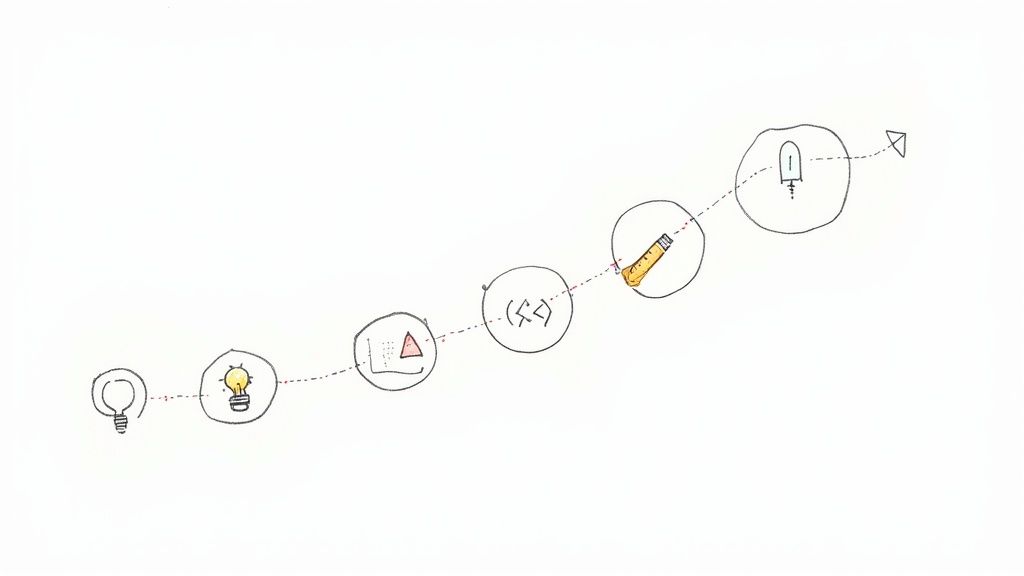
Let's be honest, the phrase product development lifecycle stages sounds a bit corporate, like something you'd see on a PowerPoint slide in a windowless conference room. But I promise you, it's less about red tape and more about having a reliable map for a very treacherous journey. It's the framework that guides an idea from that first "what if?" napkin sketch all the way to launch day and beyond.
Without a map, you are just wandering in the wilderness. A good framework turns chaotic brainstorming into a focused, step by step process, and dramatically increases the odds you'll build something people actually want.
From Messy Idea to Market Ready Product
Every great product starts as a messy, beautiful spark. But I have seen too many brilliant ideas at startups die on the vine, stuck in a loop of endless feature creep, blown deadlines, and a burned out team. Without a map, the journey from idea to reality often ends in chaos. It's a place I've been, and it's not fun.
This is exactly where the product development lifecycle comes in. Don't think of it as some rigid process meant to stifle creativity. See it for what it is: a focusing lens. It takes all that raw, creative energy and aims it squarely at solving a real problem for a real user, bringing order to the chaos.
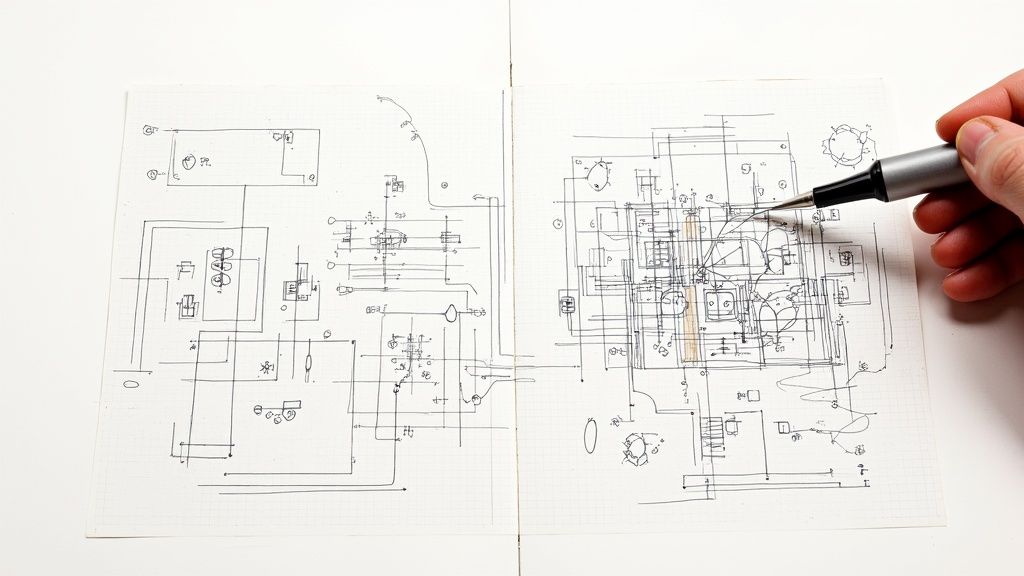
This is the journey we're talking about—from tangled beginnings to a clear, targeted goal, all thanks to a solid framework.
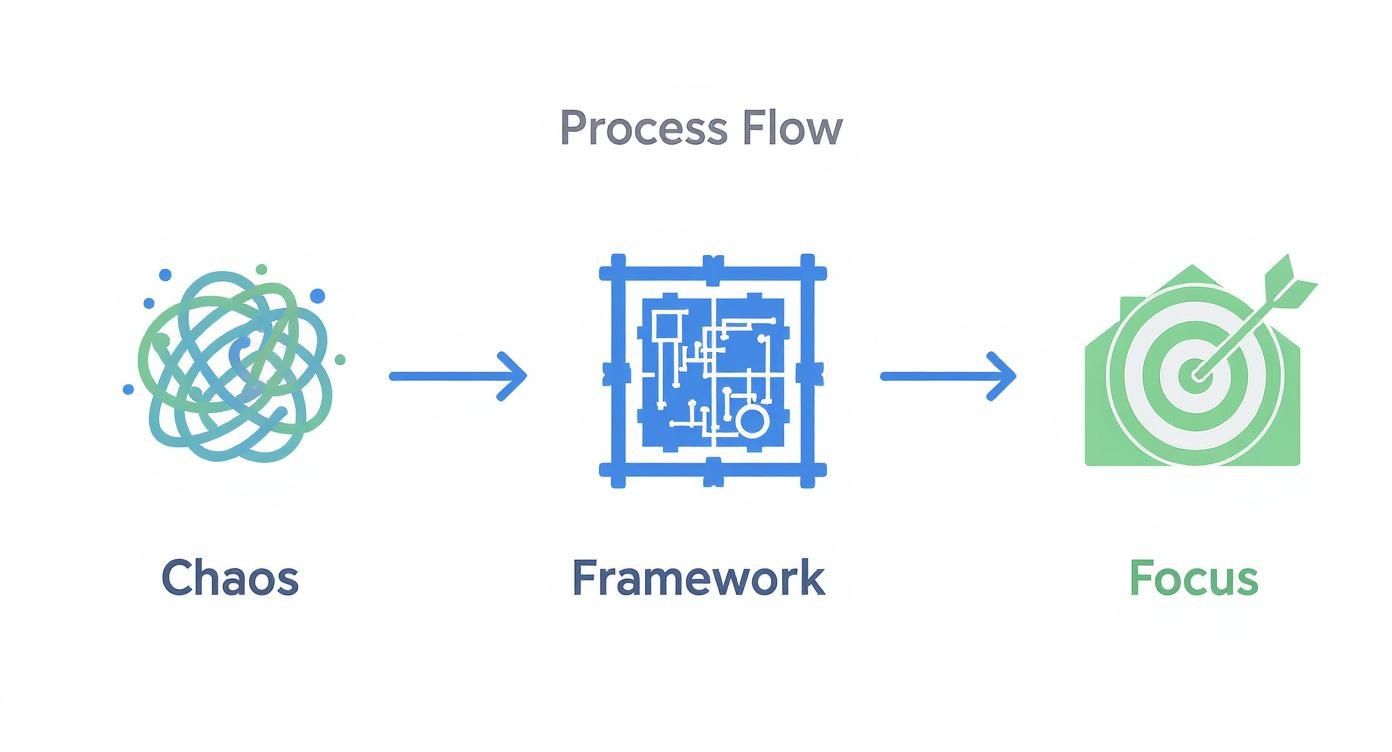
This process shows how a good framework takes all that initial complexity and straightens it into a clear, goal oriented path forward.
Why Structure Actually Liberates Creativity
It sounds completely backward, I know, but having a structure doesn't kill creativity—it channels it. When your team isn't constantly burning cycles debating what to do next or how to tackle it, they can pour all that brainpower into building the best possible solution. The lifecycle provides the guardrails so you can innovate safely within them.
The journey usually moves through key stages like idea generation, concept testing, business analysis, development, and finally, getting it out into the world. Following these steps helps manage risk and ensures the final product actually lines up with what customers need. In fact, startups that nail their business analysis can cut development time by up to 30%, which is a massive cost saving.
A framework is your team's shared language. It ensures that when a designer talks about a "prototype," an engineer understands its scope, and a product manager knows its purpose. This alignment alone prevents countless hours of rework.
Getting everyone on the same page is everything. For a deeper look at the entire process from a founder's perspective, check out this a comprehensive guide to the mobile app development lifecycle.
Building out this structure is also a huge part of creating a plan you can actually stick to. If you're currently mapping out your build, our guide on a technical roadmap template that actually works is a perfect next step.
Validating Your Idea Before Writing Code
This is the graveyard where most brilliant ideas end up. It's not because the idea was bad, but because it was a solution searching for a problem.
I once watched a founder, completely convinced he had a billion dollar idea, spend six months building a beautiful piece of software. He only discovered afterward that his target customers didn't see the problem he was solving as a real problem at all. They wouldn't pay a dime for it. Ouch.
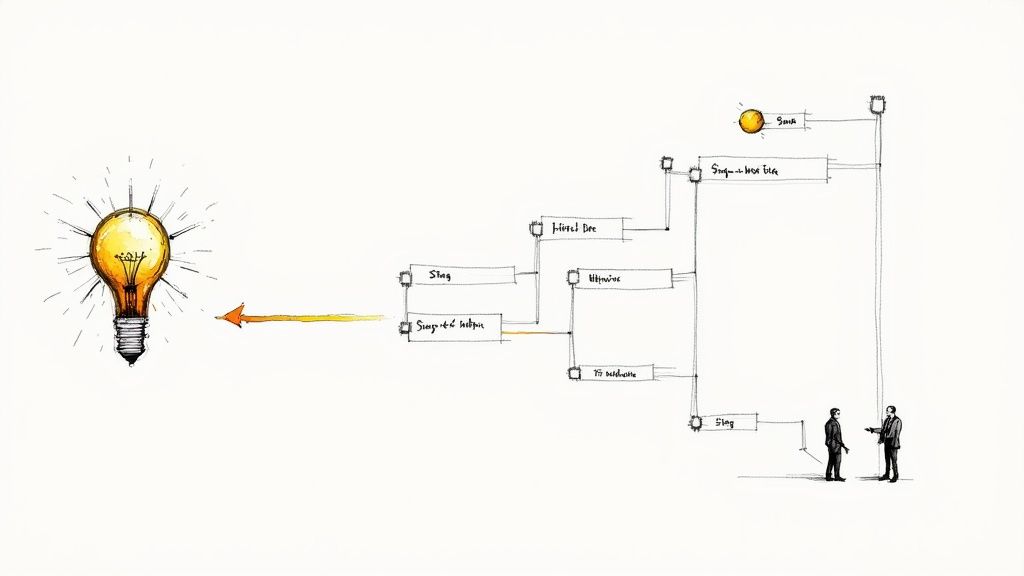
That painful—and completely avoidable—scenario is why this validation phase isn't just a step; it's the most critical foundation you can lay. We're not talking about brainstorming in a vacuum. This is about structured, intentional learning to de risk your entire venture before a single line of code gets written.
The goal here is simple but brutal: prove your assumptions wrong as quickly and cheaply as possible. You have to fall in love with the customer's problem, not your solution.
From Hypothesis To High Conviction
Your initial idea is just a hypothesis. Nothing more. Validation is the gritty process of gathering cold, hard evidence to turn that flimsy hypothesis into a high conviction bet. This means getting out of the building and talking to real people.
Over the years, I've found these techniques are the most effective for cutting through the noise:
- Problem Interviews: Talk to at least 15 to 20 potential customers. Your goal isn't to pitch your idea; it's to shut up and listen. Ask open ended questions about their workflow, their biggest headaches, and what they've already tried to do about them.
- Market Research: Who else is trying to solve this problem? Understanding your competitors isn't about copying them; it's about identifying the gaps they've missed. A competitor's very existence is often validation that a market exists in the first place.
- Smoke Tests: Before you build anything, set up a simple landing page that describes the value proposition of your future product. Then, drive a small amount of targeted traffic to it and see if people sign up for a waitlist. This tests their intent to act, which is far more valuable than their opinion.
The output of this stage isn't code. It's clarity. A validated idea saves countless engineering hours and prevents you from building a beautiful product that nobody wants.
Once you have this initial data, it's time to formalize your findings. This is where tools like a Lean Canvas or a simple Problem Statement document become invaluable. They force you to articulate precisely who your customer is, what problem you're solving, and why your solution is uniquely positioned to help.
This clarity is an absolute prerequisite for defining what an effective Minimum Viable Product (MVP) even looks like. For teams just starting this journey, understanding the nuances of an MVP is crucial, and you can get a great overview from this guide to startup MVP development services.
A Simple Validation Checklist
Before moving on, let us pause and reflect. Ask yourself if you can confidently answer these questions. This is your go or no go checkpoint.
- Is the problem real and painful? Have you heard multiple people describe the same struggle without you prompting them?
- Is the market big enough? Is there a large enough group of people experiencing this problem to build a sustainable business around?
- Will people pay for a solution? Have you seen evidence that they are already spending money or significant time trying to solve this problem today?
- Can you reach your target customers? Do you have a clear, practical idea of where these people hang out online or offline and how you might get your message in front of them?
Answering "no" or "I'm not sure" to any of these isn't a failure. It's a signal to dig deeper or pivot your idea. This is the cheapest time to make a change. Every assumption you validate now saves you from writing code that will eventually need to be thrown away.
Alright, you've survived the discovery phase. You've pounded the pavement, talked to real humans, and turned that nagging gut feeling into a solid, validated idea. High fives all around. But now the real work begins: actually building the thing.
This is where the rubber meets the road—or, more accurately, where pixels meet code. Design and development aren't separate, sequential steps; they're a tight, collaborative dance. It's the messy, exciting process of translating customer pain into a tangible product.
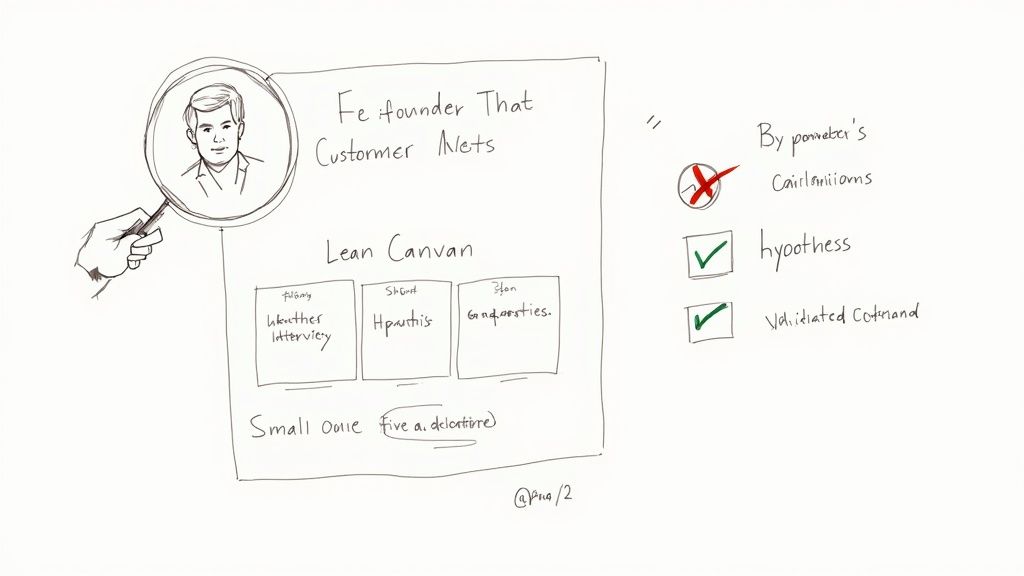
Think of this phase less like a marathon and more like a series of focused sprints. Each sprint brings your product into sharper focus, and every decision you make now can either save you weeks of work or cause massive headaches down the line.
From Scribbles to Clickable Prototypes
Before a single line of code gets written, you have to map out the user's journey. This is way more than just picking colors and fonts; it's about architecting an experience that feels so natural the user doesn't even have to think about it.
The process usually breaks down into a few key stages:
- User Flows: These are the bare bones blueprints. Simple diagrams that map out every single step a user takes to get something done. "User clicks 'Sign Up,' then sees this screen, then enters their email..." It's the logic before the looks.
- Wireframes: Once the flow makes sense, you build the skeleton. Wireframes are basic, black and white layouts. The focus here is 100% on structure and function: where does this button go? Is this form clear? Forget pretty; think practical.
- High Fidelity Prototypes: This is where it all comes to life. Using tools like Figma or Sketch, designers create a clickable mockup that looks and feels just like the final product. It's a game changer because you, your team, and even a few potential users can "use" the app before you've invested a single dollar in development.
Moving from flow to prototype is non negotiable. It lets you find and fix awkward layouts or confusing navigation when the cost of a change is just dragging a box in Figma, not rewriting a hundred lines of code.
The Art of the Minimum Viable Product
With a killer design in hand, you're faced with a brutally tough question: what's the absolute bare minimum we can build that still delivers real value? This is the soul of the Minimum Viable Product (MVP).
An MVP isn't a buggy or cheap version of your final product. It's a strategic tool for learning. Its only job is to test your biggest assumption with the least amount of effort.
Nailing down the MVP scope is one of the hardest things any startup team does. It requires saying "no" constantly. Your goal is to pinpoint that one critical feature that solves the most painful part of the problem you validated earlier. Everything else—everything—gets thrown onto the backlog. Be ruthless.
Engineering for Today and Tomorrow
Once the MVP scope is locked in, the engineers roll up their sleeves. The architectural choices made here are the foundation you'll be building on for years. No pressure.
Choosing Your Tech Stack
Founders love to agonize over this. Don't. For an early stage company, the best tech stack is the one your team already knows inside and out. Your biggest advantage is speed. Whether you're spinning up a backend with Django or crafting a snappy frontend with Next.js, go with what lets you ship fastest. Familiarity beats trendy every time.
Test Driven Development (TDD) Isn't a Luxury
I hear it all the time: "We don't have time for tests." Wrong. You don't have time not to. Test Driven Development (TDD) isn't a chore; it's a safety net that lets you move faster. By writing a test before you write the code, you're forced to think clearly about what you're building. It catches bugs before they ever see the light of day. I once got stuck on a bug for hours that a simple test would have caught in seconds. Lesson learned.
CI/CD from Day One
Set up a Continuous Integration/Continuous Deployment (CI/CD) pipeline from the first commit. This is non negotiable in 2024. Automating your testing and deployment process means you can push small changes to production multiple times a day with total confidence. This creates a powerful rhythm of building, shipping, and learning.
Architecting for What's Next
Even with an MVP, a little foresight is critical. Are you thinking about adding Generative AI or a Retrieval Augmented Generation (RAG) system later? You don't need to build it now, but you should think about it. Designing your data models and APIs to be modular from the start can save you from a complete rewrite. Think in terms of clean service boundaries today so you can easily plug in new, complex features tomorrow.
This combination of design and development is where your idea finally gets a pulse. By staying lean with an MVP and building on a solid engineering foundation, you set yourself up not just to build a product, but to build a process for continuous learning and improvement.
The code is done. The designs are locked in. It feels like you've crossed the finish line, but you've actually just arrived at the starting line for the two most nail biting stages: testing and launch. This is the moment the theoretical product smacks into the real world, and a bit of prep here pays off massively.
Think of testing less like a final exam and more like an ongoing conversation with your product. It's where your creation starts talking back, showing you where it's solid, where it's brittle, and what you completely missed. This chat happens on every level, from the microscopic to the panoramic.
From Unit Tests to User Champions
A confident launch is built on a rock solid testing strategy. After the code is written, it has to run a gauntlet of functional, usability, performance, and security testing to prove it's ready for prime time. This isn't just about ticking boxes; it's about ensuring quality.
This is where Quality Assurance (QA) becomes your secret weapon. A great QA team doesn't just hunt for bugs—they become the ultimate champions for your user. They're the ones asking the tough questions: "Sure, this button works, but is it intuitive? Is this workflow frustrating? Does this actually solve the user's problem elegantly?"
Their job is to stress test every assumption and catch the human element issues that automated scripts will always miss. They are your first, most critical users. Listening to them is non negotiable.
Choosing Your Launch Strategy
With a well tested product in hand, it's time to plan the main event. A product's success often hinges on how it's introduced to the world, making it critical to understand How to Launch an App effectively. You don't just "go live"; you pick a strategy that fits your product's maturity, your audience, and your stomach for risk.
Different products call for different rollout plans. Choosing the right one can be the difference between a smooth release and a chaotic scramble.
Launch Strategy Comparison
| Strategy | Best For | Pros | Cons |
|---|---|---|---|
| Beta Programs | New products needing real world feedback before a full release. | Gathers invaluable user insights, builds early advocates, and finds bugs in a controlled setting. | Slower to market, requires managing a feedback community. |
| Phased Rollouts | Established products with large user bases; high risk feature releases. | Drastically reduces risk. You can monitor performance on a small slice of users (e.g., 5%) and roll back if needed. | Can frustrate users not in the initial group; requires feature flag infrastructure. |
| "Big Bang" Launch | Consumer apps with a strong marketing push or products entering a competitive space. | Generates maximum buzz and excitement. Everyone gets the new features at once. | Highest risk. If something goes wrong, it goes wrong for everyone, instantly. |
The right strategy helps you manage risk and gather data, turning what could be a gamble into a calculated move.
A well planned launch transforms pre launch jitters into controlled confidence. It's the difference between hoping for the best and knowing you're prepared for whatever comes your way.
I learned this lesson the hard way. Years ago, we were hours from a major launch, and everything looked perfect. Then, disaster struck. A single, overlooked DNS setting brought the entire system down during our final checks. We caught it just in time, but it was a heart stopping reminder that the smallest details can have the biggest consequences.
That experience burned the need for a launch day checklist into my brain. A detailed, step by step plan is your best defense against chaos, ensuring nothing gets missed in the heat of the moment. We've even built a resource to help you get started; check out your essential product launch checklist template. Having that document turns a frantic day into a calm, methodical process.
Thriving and Iterating After Launch
Congratulations, you launched. Seriously, pop the champagne. The team is celebrating, you've hopefully taken a moment to breathe, and the product is officially live.
But the launch isn't the finish line. It's the starting gun for the real race. This is the moment the product development lifecycle flips on its head. The focus shifts dramatically from building to a ruthless cycle of measuring, learning, and iterating.
Let's be honest: your launch day product is the worst version that will ever exist. That's not an insult—it should be your goal. From this day forward, every single change needs to be guided by what real users are doing, not just what the team thinks they'll do.
The real learning starts now.
Seeing What Your Users See Before They Do
The most terrifying feeling after a launch is silence. Is everything okay? Is anyone using the feature? Is something silently breaking in a corner of the system? You absolutely cannot afford to wait for angry support tickets to roll in before you find out something is wrong.
This is where observability comes in.
Observability isn't just a fancy word for monitoring. Monitoring tells you that something is happening; observability is about building a system that can tell you why. Think of it as your product's nervous system. It has three core components you need from day one:
- Logging: These are your application's diary entries. Every important event, from a user signing in to a critical database error, should be written down. When something inevitably goes wrong, detailed logs are the first place your engineers will look.
- Monitoring: This is the dashboard with all the blinking lights. It tracks key metrics in real time—CPU usage, API response times, database load. It's the high level, at a glance view of your system's health.
- Alerting: This is what pages your on call engineer at 3 AM when the monitoring dashboard turns red. Properly configured alerts are proactive; they scream about a potential problem before it becomes a catastrophe for your users.
Setting up this trifecta isn't a "nice to have." It's the difference between flying completely blind and having a full instrument panel in the cockpit.
Building a Powerful Feedback Loop
While observability tells you what your system is doing, you also need to know what your users are thinking. This means creating a deliberate, structured process for collecting, organizing, and actually acting on what they tell you.
Your users are literally giving you a roadmap to make your product better. Your only job is to listen.
Your product roadmap should be a living document, constantly re prioritized based on the feedback loop you build. The best features are rarely the ones you dream up in a conference room; they're the ones your users are practically begging you for.
And this is way more than just setting up a [email protected] inbox. A robust feedback loop is a machine with several inputs working in concert:
- Support Tickets: This is your front line. Every ticket is a story about a point of friction or a missing piece. Use tags to categorize issues (e.g., "billing confusion," "UI bug," "feature request") so you can spot trends instead of just fighting individual fires.
- Social Media & Communities: People are talking about your product on Twitter, Reddit, or industry forums. You need to be there. Set up listening tools to catch these mentions. The feedback here is often brutally honest and unfiltered—which is exactly what you need.
- Analytics: Tools like Google Analytics or Mixpanel show you what users do, not just what they say. Are they dropping off at a certain step in the signup flow? Are they completely ignoring that shiny new feature you just spent a month building? The data doesn't lie.
Once you have this raw data, the next step is to process it. A simple system using a tool like Trello or Jira can work wonders. Funnel all feedback into a single backlog, ruthlessly prioritize it based on impact and effort, and—this is crucial—close the loop by letting users know when you've shipped something they asked for.
This cycle—build, measure, learn—is the engine of continuous improvement. It transforms the product development lifecycle from a straight line with a finish date into a powerful, self correcting loop, driving your product closer and closer to true market fit with every single turn.
Common Pitfalls and How to Avoid Them
Every team stumbles. The journey through the product development lifecycle is absolutely littered with trapdoors and wrong turns. The trick isn't to never make mistakes—it's to learn from them without the pain of making them all yourself.
I've seen brilliant teams get derailed by the same handful of preventable errors. So, let's walk through the most common ones, not as scary bedtime stories, but as practical lessons you can use right now.
Underestimating the Validation Stage
This is the big one. It's the siren song of "we just know what the customer wants" that leads ships to crash against the rocks. Building a beautiful product that nobody asked for is the most expensive mistake you can make, period.
- The Lesson: Your idea is a hypothesis, not a fact. Falling in love with your solution before you've even confirmed the problem is a fatal flaw.
- The Fix: Get relentless about validation. Seriously. Talk to at least 15-20 potential users before a single line of code gets written. If they aren't already trying to solve this problem with janky spreadsheets or duct taped solutions, the pain might not be real enough to build a business on.
Letting Technical Debt Pile Up
"We'll fix it later." Ah, the famous last words of countless projects. In the mad dash to ship, teams often take shortcuts, leaving a trail of messy code, non existent documentation, and skipped tests. This technical debt acts like a tax on all future development, grinding everything to a halt.
Technical debt is insidious. It starts small, but it compounds interest over time until you're spending all your energy just trying to keep the lights on instead of building new value.
This debt also makes any future work incredibly difficult to scope. If you're wrestling with this, our guide to a realistic software project estimate can help you get a better handle on your timelines.
Poor Communication Between Teams
It's the classic silo problem. Engineering doesn't understand why product needs a feature right now. Product doesn't get the technical trade offs involved in their request. This disconnect is a breeding ground for friction, rework, and resentment.
- The Lesson: Alignment isn't a one time meeting; it's a continuous practice.
- The Fix: Implement shared rituals. Daily stand ups, weekly demos where engineering actually shows what they've built, and regular roadmap reviews where product explains the "why" behind the work are all non negotiable. Make empathy a core part of your culture.
Your Questions, Answered
A few common questions pop up whenever I talk about the product development lifecycle. Let's tackle them head on.
Which Stage Is The Most Critical For a New Product?
If you held me to just one, it's the validation stage. I can't hammer this point home enough. Building the most beautiful, technically perfect product is a monumental waste of time if nobody actually has the problem you're solving.
Think of it this way: a mistake in the development phase can be fixed with more code. A mistake in the validation phase can kill your entire company before it even gets started. This is the stage that saves you from yourself—from building something nobody wants.
How Does This Framework Change For Different Team Sizes?
The product development lifecycle is a flexible framework, not a rigid set of commandments. It scales up or down with your team.
- For a solo founder or a tiny crew: You're wearing all the hats. The stages will blur together. One afternoon you're doing customer interviews (validation), and the next morning you're sketching wireframes (design). The trick is to be conscious of which "mode" you're in so you don't skip a crucial step.
- For a larger startup: Now you have specialized roles. A product manager owns validation, a designer owns the prototypes, and engineers own development. The stages become much more distinct, with clear handoffs and deliverables. The framework is what keeps everyone rowing in the same direction.
How Do You Manage Scope Creep Mid Cycle?
Ah, scope creep—the silent killer of timelines and budgets. It usually starts with a seemingly harmless request: "Hey, while you're in there, can we just add one more button?"
The best defense is a strong offense built on clear, honest communication.
When a new feature request comes in, don't just say "no." Instead, frame it as a trade off: "Yes, we can definitely do that. Which of our current priorities should we push back to make room for it?"
This simple question reframes the entire conversation. It forces the team to weigh the new request against existing commitments, making the true cost of the change visible to everyone. A well defined MVP scope from the start is your best shield against this.
Need to build a robust, scalable system without stumbling into the common pitfalls? As a full stack engineering consultant, Kuldeep Pisda helps early stage startups accelerate their roadmaps and build strong technical foundations. Let's build your next product the right way.
Subscribe to our newsletter.
Become a subscriber receive the latest updates in your inbox.

Member discussion